The First 25 Years of Washington Glass School

Michael Janis on glass, public art, and 20 years in the Mt Rainier Gateway Arts District

Michael Janis cutting glass in the Washington Glass School studio in 2025.

Michael Janis is a contemporary glass artist and public art sculptor based in Washington, DC. He is a co-director of the Washington Glass School, an artist-run studio and educational center focused on contemporary glass practices.

In 2026, Washington Glass School marks 25 years since its founding and 20 years since establishing its home in Mount Rainier, Maryland. Janis became co-director of the school in 2005, shortly before the previous studio site in Washington, DC was taken through eminent domain for the development of Nationals Park.

Washington Glass School at 1338 Half Street SE in Washington, DC, before relocation for Nationals Park.
Washington Glass School at 1338 Half Street SE (now Nationals outfield)

Janis is known for narrative glass sculpture, community-engaged public art, and memorial projects addressing identity, memory, and social history. His work appears in permanent museum collections, including the Art Institute of Chicago, the Tacoma Museum of Glass, and the Museum of American Glass, among others. He has completed public art commissions for libraries, medical centers, and civic spaces throughout Washington, DC, the Mid-Atlantic region, and beyond.

Michael Janis riding a horse in front of Washington Glass School in 2012.
Michael Janis riding a horse in front of Washington Glass School, 2012

We spoke with Michael Janis about the history of Washington Glass School, his studio practice, and the role of glass in public art and memorial projects.

Q: Washington Glass School is marking 25 years, with 20 years in Mt Rainier. What does this milestone represent for you?

Michael Janis:
The 25-year mark reflects the value of being anchored while continuing to adapt.

Washington Glass School began in 2000 in Washington, DC. I became co-director in 2005, shortly before the original studio site was taken through eminent domain for the construction of Nationals Park. Losing that space forced a reset. We relocated to Mt Rainier and rebuilt the school from the ground up.

The move to Mt Rainier came as we expanded education programs, developed public art work, and built long-term partnerships with artists and communities. Reaching 20 years in the Gateway Arts District shows the importance of stability for an arts organization after a period of displacement and transition.

Michael Janis teaching a glass class in front of a kiln at Washington Glass School in 2007.
Interior of Washington Glass School, 2007, teaching at kiln

Q: How did becoming co-director in 2005 shape the direction of the school?

Michael Janis:
Becoming co-director in 2005 placed me in a leadership role during a period of disruption.

The loss of the original DC studio meant the school had to redefine the business model, the student base, and the physical layout. We focused on building a tight and adaptable studio space, reworking class offerings, and creating a framework for contemporary glass practices.

Michael Janis teaching an architectural plate glass class in 2005.
Michael Janis teaching an architectural plate glass class at Washington Glass School in 2005.

From the start, we saw the school as both a teaching center and a working studio. That combined role became the basis for how we developed public art projects and community-based programs.

Michael Janis working with community members during a glass workshop at Washington Glass School.
Community workshop for Peppermill Community Center

Q: What is the core mission of Washington Glass School today?

Michael Janis:
The core mission is supporting contemporary glass art through education, studio practice, and public art work.

We teach a wide range of glass techniques, including kilnforming, casting, and architectural glass. We also host artist talks, exhibitions, and workshops.

Another major part of the mission involves community engagement. We recently worked with military veterans through an arts therapy program developed by the Museum of Glass in Tacoma, Washington. We also work with local residents, students, and partner organizations to create glass components for public art projects placed in civic spaces.

Military veterans participating in the Hot Shop Heroes glass workshop at Washington Glass School in 2023.
Hot Shop Heroes military veterans workshop, 2023

Q: What kind of art do you make in your own practice?

Michael Janis:
I make narrative sculptural glass art.

My studio work focuses on figurative glass sculpture and relief panels. The work addresses identity, emotional presence, and social experience.

In public art, I design large-scale glass installations and memorials for civic spaces. Many of these projects include community participation, where local residents help create glass components that become part of the finished artwork.

Wall-mounted glass artwork titled Scattering of Light by Michael Janis, 2024.
Low poly wall artwork “Scattering of Light,” 2024

Q: How does glass function in your public art and memorial projects?

Michael Janis:
Glass interacts with light, reflection, and transparency.

These qualities support narrative work in both studio and public art settings. In figurative sculpture, distortion and reflection suggest emotional states. In memorial projects, glass holds collective memory through light and color.

Glass also works well in civic architecture. It allows light to pass into buildings while carrying imagery and text.

Detail of the glass sculpture Telling Our Stories at Peppermill Community Center.
Detail of Peppermill Community Center sculpture “Telling Our Stories…”

Q: What are some examples of public art projects developed through Washington Glass School?

Michael Janis:
Washington Glass School has served as the studio base for a range of public art commissions.

Recent and ongoing projects include:

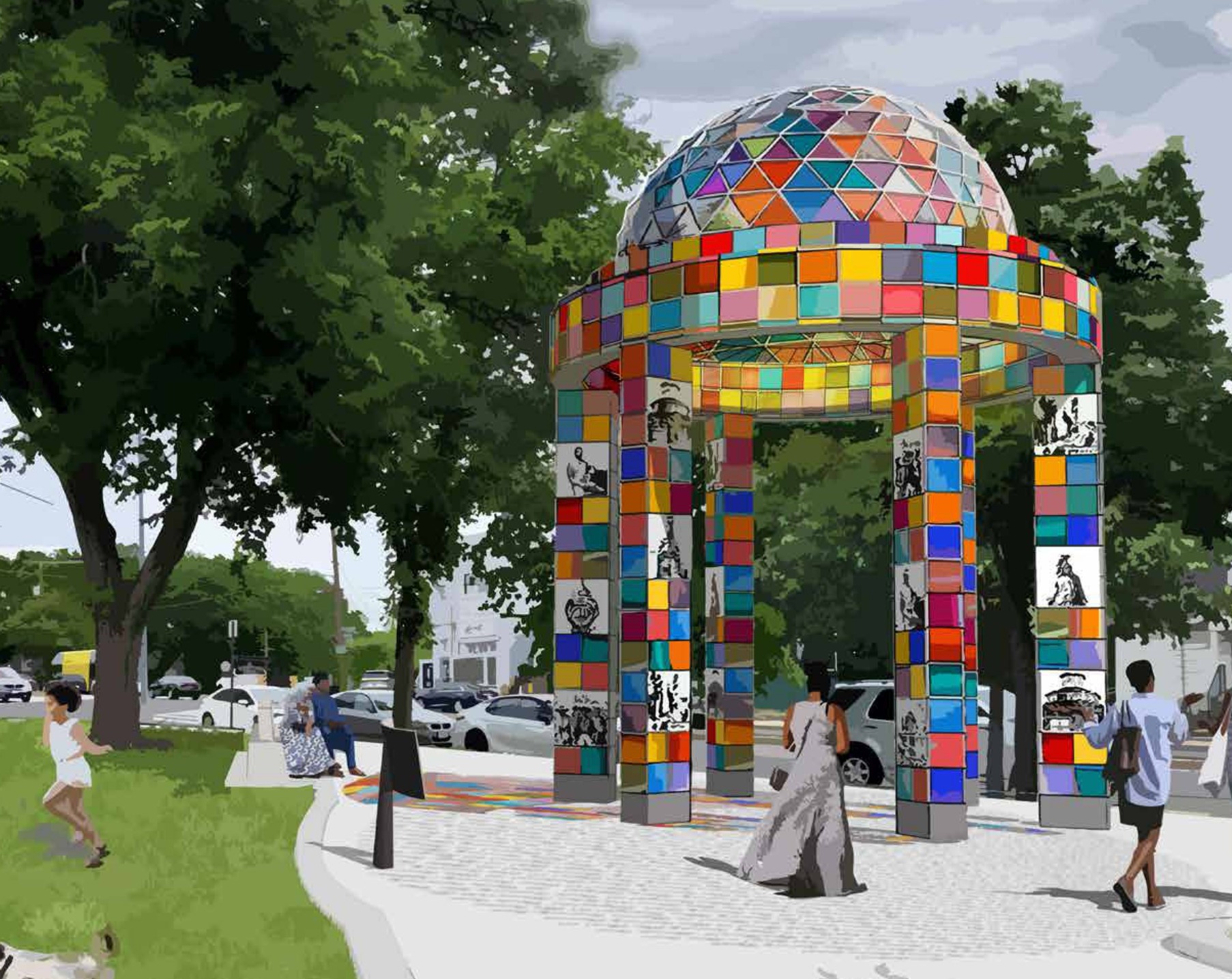
  • A DC Ward 5 community-based glass memorial honoring the enslaved people who built the U.S. Capitol
  • Glass and bronze sculpted artwork for the Library of Congress Adams Building Monumental Doors
  • A large-scale glass installation for Laurel Library in Maryland
  • A public art commission for Cedar Hill Regional Medical Center in Washington, DC
  • A community-engaged glass project in Historic Kempsville, Virginia

Each project involved collaboration with architects, government agencies, and community members.

Michael Janis in front of his public art installation at Cedar Hill Medical Center in Washington, DC.
Michael Janis at Cedar Hill Medical Center artwork (screen grab from East of the River)

Q: Why is community participation central to your public art process?

Michael Janis:
Community participation changes the role of public art.

Local residents take part in creating glass tiles, panels, and imagery. These components become part of the finished artwork installed in shared spaces.

This process builds connection between people and the artwork. In memorial projects, participation also helps address historical and social topics through shared making rather than top-down design.

Q: Where can people see your work in public or in museum collections?

Michael Janis:
My work appears in permanent collections such as:

  • The Art Institute of Chicago
  • The Tacoma Museum of Glass
  • The Fort Wayne Museum of Art
  • The Fuller Craft Museum, Massachusetts
  • The Museum of American Glass, New Jersey

Public installations appear at:

  • The Library of Congress Adams Building
  • Laurel Library, Maryland
  • Cedar Hill Regional Medical Center, Washington, DC
  • Community sites throughout Washington, DC

Q: What themes run through your work as a contemporary glass artist?

Michael Janis:
The main themes involve identity, memory, and emotional presence.

In the studio, I focus on figurative glass sculpture addressing psychological states and social relationships.

In public art, I focus on collective memory and historical narrative.

Across both areas, light and reflection create a relationship between the artwork and the viewer.

Q: How do you see the future role of Washington Glass School?

Michael Janis:
Washington Glass School will continue to support contemporary glass practices.

We will expand education programs, public art partnerships, and community-based projects. Many of the studio’s resident artists become instructors and contribute new workshop ideas.

The school will also remain a working studio for public art production and artist collaboration.

Q: What advice would you give to artists interested in glass and public art?

Michael Janis:
Develop a strong studio practice. Learn how to work with architects, engineers, and fabricators.

Understand public art as a long-term commitment to shared spaces and community needs.

For More About Michael Janis

Links:

[Michael Janis: Washington Glass Artist and Sgraffito Glass Art]
[Faculty & Staff | Washington Glass Studio]
[Michael Janis – Wikipedia]
[Public Art/ Monuments | Washington Glass Studio]

New year. Same studio. Slightly more superpowers.

Three mild-mannered artists. One studio. Twenty-five years of heat, pressure, and improbable strength.

2026 arrives with momentum, memory, and a few surprises we’re not quite ready to name.
Let’s just say: it’s a year shaped by long friendships, shared risks, and the kind of collective energy that doesn’t happen overnight.

We’ll be revealing things as the year unfolds—
not all at once, not too fast.
That’s part of the fun.

Happy New Year from all of us at Washington Glass School.
Keep your eyes open.

Washington Glass School Artists Featured in Major Museum Gift

Washington Glass School is excited to share that co-directors Michael Janis and Tim Tate are among the artists included in a significant new acquisition by The Baker Museum in Naples, Florida. The museum has received The Dr. Laurence and Rita Sibrack Collection of Contemporary Glass and Ceramics, a gift that brings 74 works by 60 artists into the museum’s permanent collection.
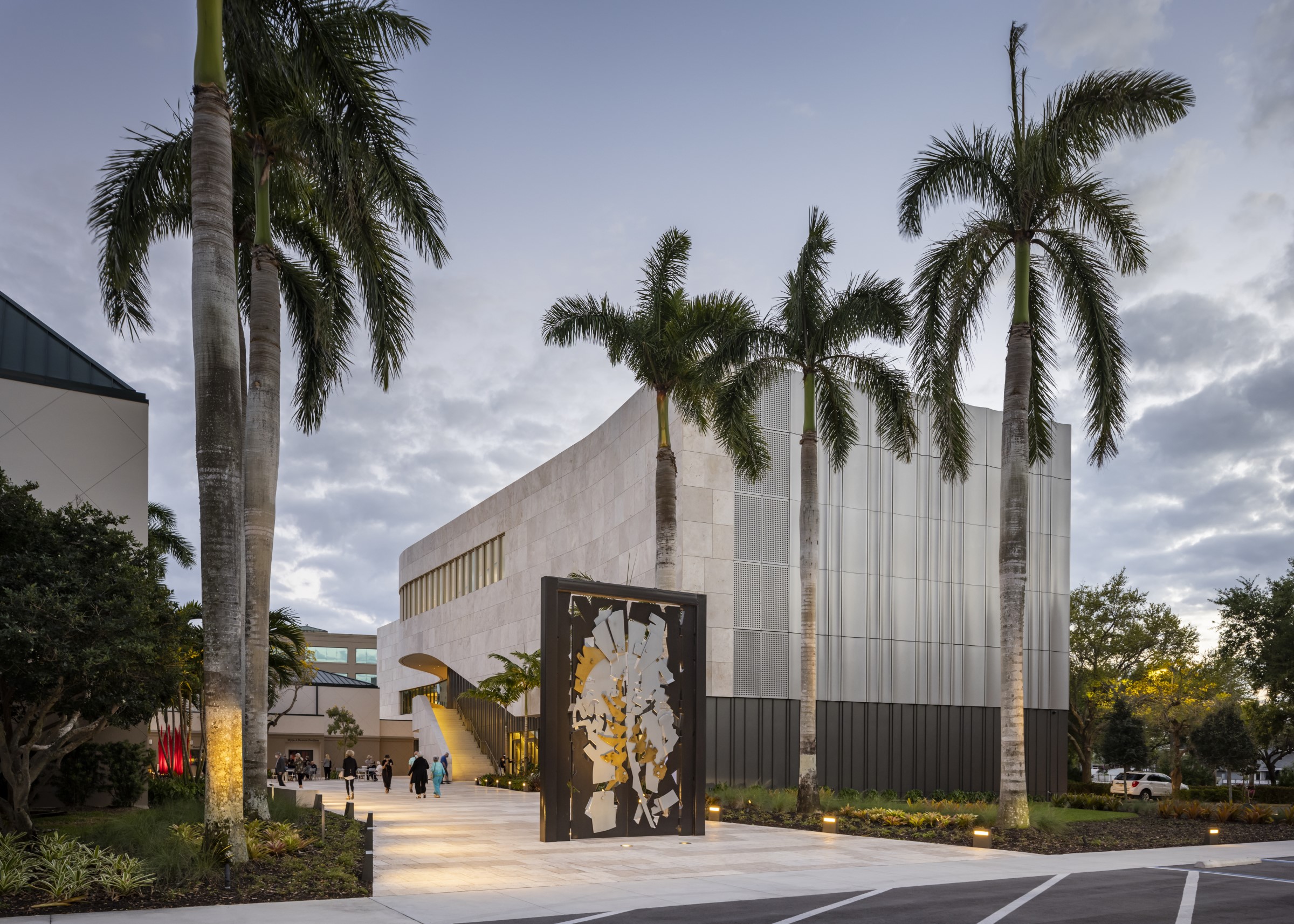
The Baker Museum in Naples, FL

The Sibrack Collection includes works by some of the most influential names in contemporary glass and ceramics, including Dale Chihuly, Judith Schaechter, Amber Cowan, Preston Singletary, Lucio Bubacco—and now, Michael Janis and Tim Tate. This collection spans nearly every major glass technique, from flame-worked to blown and cast, and reflects a deep appreciation for material, form, and light.

The Baker Museum’s decision to fully integrate these works into its broader holdings marks a continued shift in how museums value glass and ceramics—not as separate from fine art, but as essential parts of its story. For Janis and Tate, who have each spent decades advancing contemporary glass as a narrative and conceptual art form, this recognition is especially meaningful.

“Our work is about storytelling through material,” said Michael Janis. “Being included in a collection like this, which treats glass as a vehicle for meaning and not just decoration, affirms why we do what we do.”

Tim Tate added, “What the Sibracks have built is not just a personal collection—it’s a statement about the relevance and emotional range of glass today.”
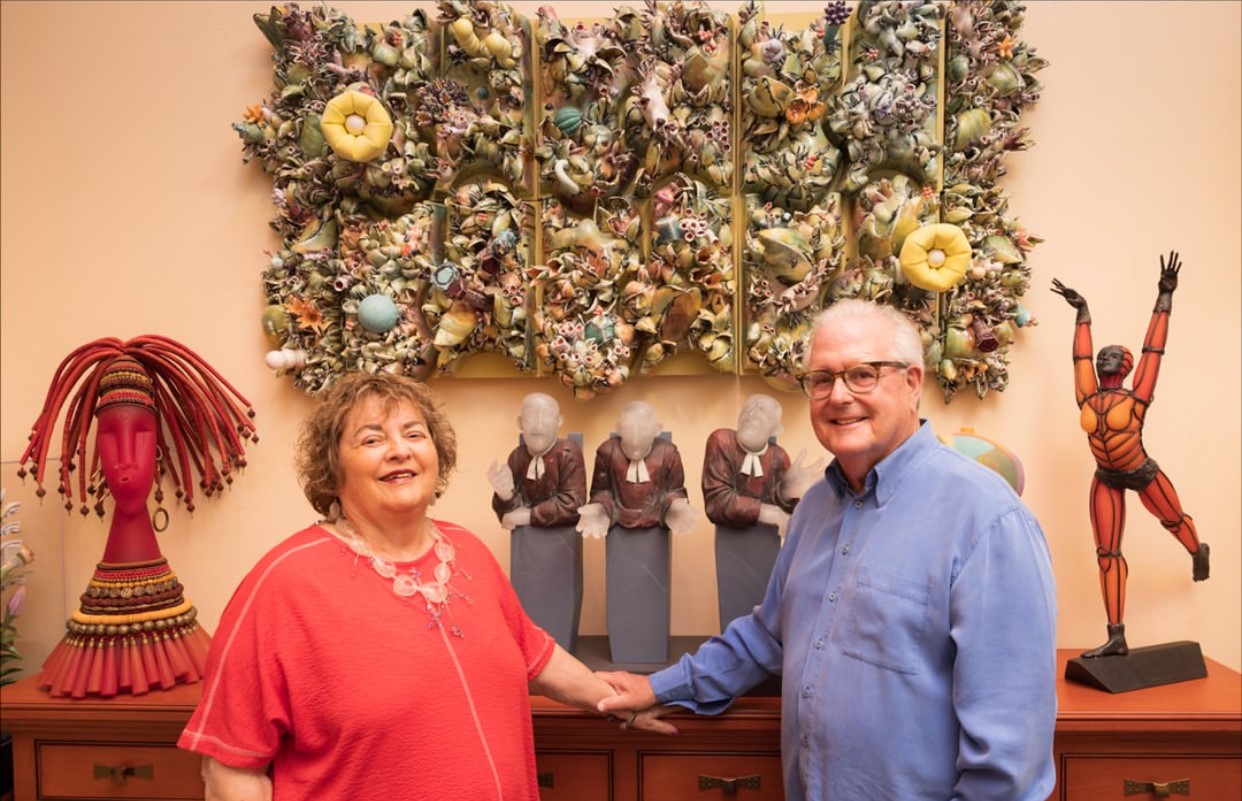
Rita and Dr Laurence Sibrak

The Sibracks, longtime supporters of Artis—Naples, were first inspired by a 2000 exhibition of Chihuly’s work at the museum. Their decision to make this donation stems from a long commitment to both the institution and the idea that art should be lived with, shared, and accessible to all.

This acquisition places the work of two DC-based artists into one of the most respected collections in the region, further establishing the impact of the Washington Glass School on the national stage. We’re proud to see Michael and Tim’s work recognized alongside such powerful voices in the field and grateful to the Sibracks and the Baker Museum for helping bring greater visibility to the language of glass.

The collection will be celebrated in the upcoming exhibition “The Passion of Collecting: Stories in Glass and Ceramics from the Sibrack Collection,” opening January 10, 2026 at The Baker Museum and remaining on view through the fall.

Following is a complete list of artists in the The Dr. Laurence and Rita Sibrack Collection of Contemporary Glass and Ceramics: Dean Allison, Adrian Arleo, Michael Behrens, Susan Beiner, Alex Bernstein, Charles Birbaum, Christina Bothwell, Peter Bremers, Emily Brock, Lucio Bubacco, Jim Budde, Nancy Callan, Dale Chihuly, A-Mi Choi, Amber Cowan, Dan Dailey, Stefen Dam, Laura Donefer, Michael Glancy, Peter Hora, Agnes Husz, Jannet Iskander, Martin Janecky, Michael Janis, William Kidd, Sabrina Knowles, Velarde Kukuli, K. William LeQuier, Dianne Martin Lublinski, Emma Luna, Robert Mickelsen, Shelley Muzylowski Allen, Harumi Nakashima, Sybelle Peretti, Lindsay Pichaske, Jenny Pohlman, Clyfford Rainey, David Regan, Colin Reid, Ross Richmond, George Rodriquez, Davide Salvadore, Judith Schaechter, Livio Seguso, Preston Singletary, Carmen Spera, Kristen Stingle, April Surgent, Matthew Szösz, Etsuko Tashimu, Tim Tate, Tip Toland, Margit Tóth, Hidenori Tsumori, Sam Tuffnell, Janusz Walentynowicz, Patti Warashina, Ann Wolff, Loretta Yang and Mary Ann Zynsky.

To learn more about the museum and the artists in the collection, visit artisnaples.org.

Michael Janis’ Art Ignites the Bergstrom-Mahler Museum’s “Catching Fire” Auction

Michael Janis “The Pale Dawn” photo credit Pete Duvall.

Co-Director Michael Janis’ glass sgraffito panel “The Pale Dawn” will be part of the Bergstrom-Mahler Museum of Glass’s Live Auction “Catching Fire” on June 11 – an artful virtual auction featuring over 100 glass artworks and experiences with proceeds supporting the participating artists and the BMM Glass educational programs. Bid on silent auction items June 4–14, with a live virtual auction June 11th at 6:45pm CST. 

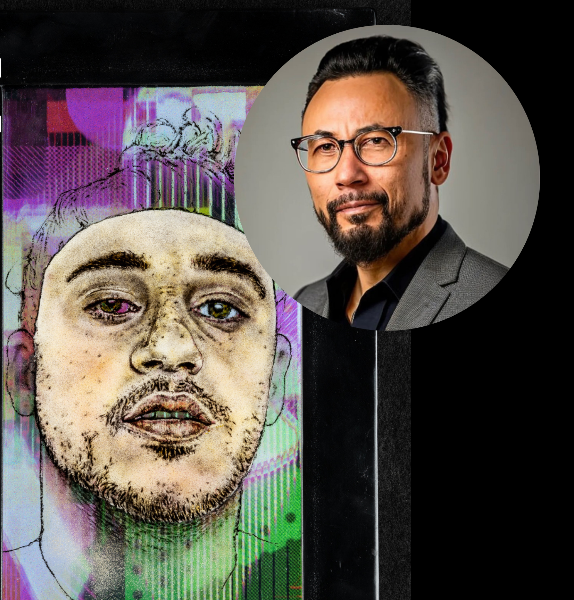
The work “Pale Dawn” is a portrait that leans into quiet tension—between realism and abstraction, softness and structure. The figure is set against blocks of muted olive and turquoise, with black powdered frit forming the clothing and gradually dissolving into the white background. There’s a sense of stillness in her gaze, but also a bit of mystery in how the form starts to fade at the bottom.

fused glass art figurative sgraffito
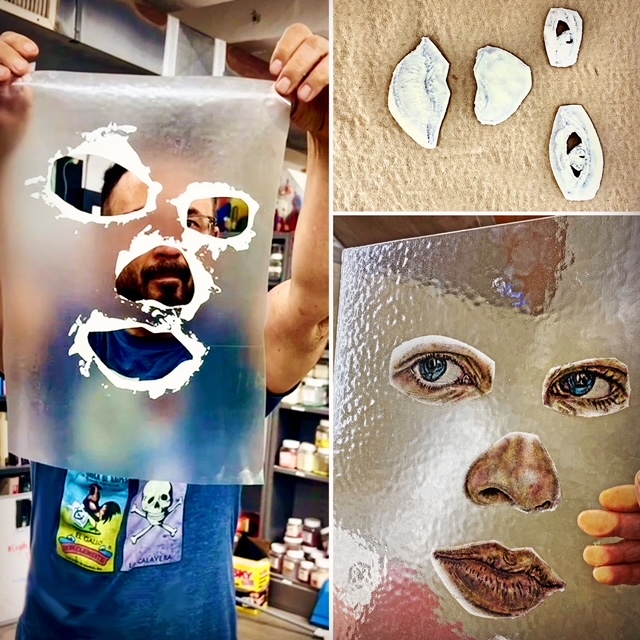
Michael Janis studies for “The Pale Dawn” showing how color and pattern were investigated.

We’ve included some of the early studies for color and detail to show how the piece came together—those small experiments helped evolve and shape the final direction.

Check it out the work on the BMM auction site https://event.gives/catchingfire/items

Commemoration of the Slaves who Built the US Capitol

Glass art by Michael Janis

The recent order from President Trump to rescind DEI (Diversity, Equity, and Inclusion) programs has led to a noticeable downplaying of Black History Month across government agencies. The U.S. State Department, for instance, has prohibited public events or messages celebrating the month, which has been a staple of American culture since the 1970s.

Michael Janis’ design for DC Ward 5 Memorial

In contrast, local organizations in Washington, DC, are stepping up to honor Black history and contributions. The Lamond Riggs Library Friends, in collaboration with the DC Office of Planning, is hosting Foundations of Freedom: Recognizing the Enslaved People Who Built the U.S. Capitol. This special event will introduce WGS Director Michael Janis’ design for a new DC Memorial to Honor the Enslaved People Who Built the U.S. Capitol for Ward 5. Along with DC’s Office of Planning staff, Michael will offer an overview of a public art proposal. The program will include storytelling, a discussion of the design process, and a Q&A session to engage the community.

Thursday, February 6, 2025 from 1 pm – 3 pm @ Lamond-Riggs DC Public Library, 5401 South Dakota Ave NE, WDC.

For more information – click on link to jump to DCPL site: https://dclibrary.libnet.info/event/12875262

Join DC Community Public Art Workshop Presentation June 22nd

The upcoming community presentation on June 22nd at the Landon Park Recreation Center will provide a platform for Ward 5 residents to view and discuss the proposed design for the memorial. This event is not only a preview of the memorial but also an invitation for the community to contribute their voices to this landmark project.

The memorial aims to be a poignant reminder of the systemic racism and exploitation that have marred American history, while also celebrating the resilience and enduring legacy of those who were enslaved. Situated in the nation’s capital, this tribute will join the ranks of many other monuments and memorials, enriching the narrative with stories of those who have been historically marginalized. As the Nation’s capital, monuments and commemorative works have typically been focused on or reserved for commemoration to individuals or subjects of national importance within the monumental core, the original L’Enfant City, and mostly in Wards 1, 2, 3, and 6. Many of these subjects participated in slavery, systemic racism, and the mistreatment of, or took actions that suppressed equality for, persons of color, certain groups of people, and women.

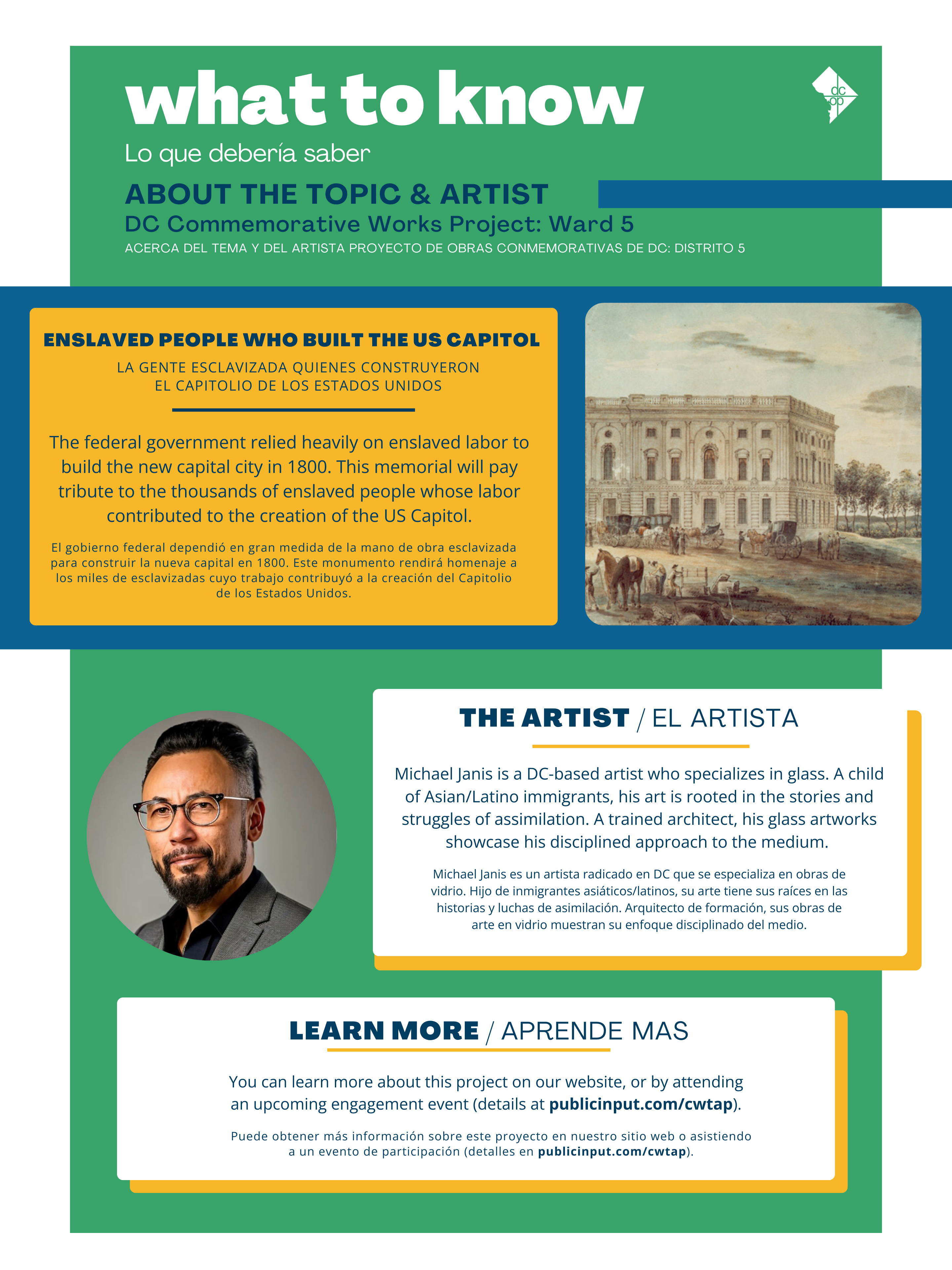
In a historic move to acknowledge and honor the invaluable contributions of enslaved individuals who helped build the U.S. Capitol, the DC Commission on the Arts and Humanities (CAH), in collaboration with the DC Office of Planning (OP), has selected WGS Co-Director Michael Janis to design the Ward 5 Public Art Memorial. This significant project aims to shed light on the often-overlooked role of over 200 enslaved people whose labor laid the foundation for one of the most iconic symbols of democracy.

Date: June 22, 2024

Time: 2:00 PM – 4:00 PM

Location: Landon Park Recreation Center, 2901 20th St NE, Washington, DC 20018

Janis, Co-Director of the Washington Glass School (WGS), has been actively engaging with the DC Ward 5 community to ensure that the memorial resonates with the local residents and accurately reflects the historical significance and human stories behind the Capitol’s construction. This community-centered approach underscores the importance of collective memory and inclusivity in public art.

DC’s Commemorative Works Program reviews proposals submitted by sponsors, but since the program was established in 2001 has received only a handful of applications for local subjects. OP’s Commemorate DC work includes technical assistance to community partners in Wards 4, 5, 7, and 8 to identify commemorative subjects and sites before supporting efforts in Wards 1, 2, 3, and 6. The Office of Planning’s partners are convening meetings with community groups and residents to discuss subjects to commemorate, appropriate sites, and concept designs of commemorative works. Concept designs will be reviewed by the Commemorative Works Committee who will make a recommendation on each proposal to the Mayor and District Council, who have final review and approval. A link to the 4 initial Commemorative projects here.

The DC Public Art Memorial is more than a work of art; it is a symbol of reconciliation, education, and recognition. It will invite all visitors to reflect on the past and encourage ongoing dialogue about equality and justice.

Join Michael Janis, the DC CAH & OP along with the Ward 5 community on June 22nd to participate in the outlining of a project that seeks to honor the past and inspire a future of inclusivity and acknowledgment. This is an important occasion for Washington, DC, and for the nation, as we begin this transformative initiative. 

 More images and info on Michael Janis’s project here : http://washingtonglassschool.com/wgs-michael-janis-selected-as-artist-to-create-new-washington-dc-memorial

WGS’ Michael Janis Selected as Artist to Create New Washington, DC Memorial

New Memorial Concepts for Washington, DC

As the nation’s capital, Washington, DC is home to many monuments and memorials honoring individuals and events of national significance mainly within the monumental core, the original L’Enfant City, and mostly in Wards 1, 2, 3, and 6. Many of these subjects participated in slavery, systemic racism, and the mistreatment of, or took actions that suppressed equality for, persons of color, certain groups of people, and women.
The DC Commission on the Arts and Humanities (CAH), in partnership with the DC Office of Planning (OP) selected WGS Director Michael Janis as the artist to create DC’s Ward 5 Public Art Memorial to commemorate the Enslaved People Who Built the US Capitol.
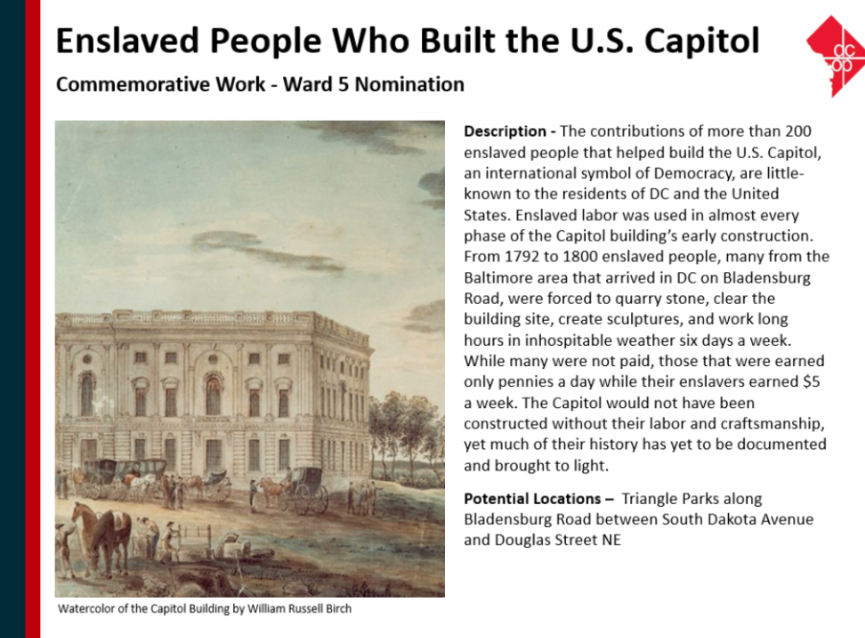
Contributions of more than 200 enslaved people helped build the U.S. Capitol, an international symbol of Democracy.

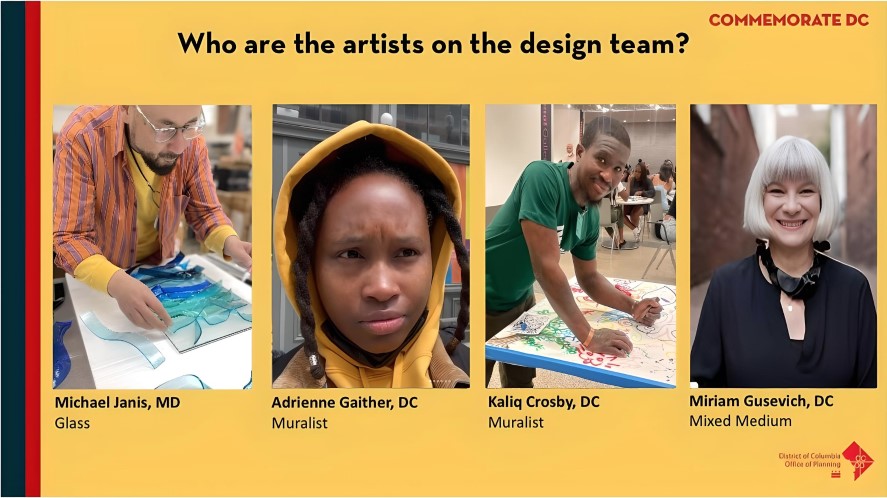
Artists engaged by DC CAH to create the new Public Art

From 1792 to 1800 enslaved people, many from the Baltimore area, arrived in DC on Bladensburg Road and were forced to quarry stone, clear the building site, create sculptures, and work long hours in inhospitable weather six days a week.

DC Ward 5 Public Art Memorial

The Capitol would not have been constructed without their labor and craftsmanship, yet much of their history has yet to be documented and brought to light.

Michael has been meeting with the Ward 5 community groups and the first community presentation of the concept is scheduled for June 22, 2024, from 2-4 pm at the Landon Park Recreation Center, 2901 20th St NE, Washington, DC 20018.

Promotion of Public Art Project featuring Michael Janis “The Artist”.

If you are interested in participating – click link to sign up (at bottom of page) for updates from Commemorate DC. Don’t miss out on this incredible opportunity to be a part of history!

Habatat Detroit Fine Art Q & A with Michael Janis

RSVP now for a Habatat-Zoom event taking place this Saturday, November 16th, at 1:00 p.m. ET.

Join Aaron Schey (aka Mr Glass) Owner and partner of Habatat Detroit Fine Art, for an engaging update on the WGS Director Michael Janis, an innovative member of the esteemed Habatat Family. Janis, who showcased his work at Habatat’s Scope Art Miami booth this year, will provide insights into the latest developments in his career and sculpture.

Ok. what the what is going on?

Notably involved in the arts community near Washington D.C., Janis has been actively creating public sculptures and exploring new artistic endeavors incorporating video technology.

Save the date for March 2024, as Janis will be showcased as a distinguished artist at the Lowe Art Museum in Miami. Additionally, experience his exceptional work during the Glass Coast Weekend in Sarasota, Florida, where he will be personally present to share his artistic journey. Your presence is highly anticipated!

RSVP (free online presentation) link: Meeting Registration – Zoom

Happy Holidays from Washington Glass School and Studio

Tis the Season!

All of us at the Washington Glass School & Studio Wish You and Family a Joyous Holiday Season! And a Happy Healthy New Year!

Artists and Educators from the Washington Glass School

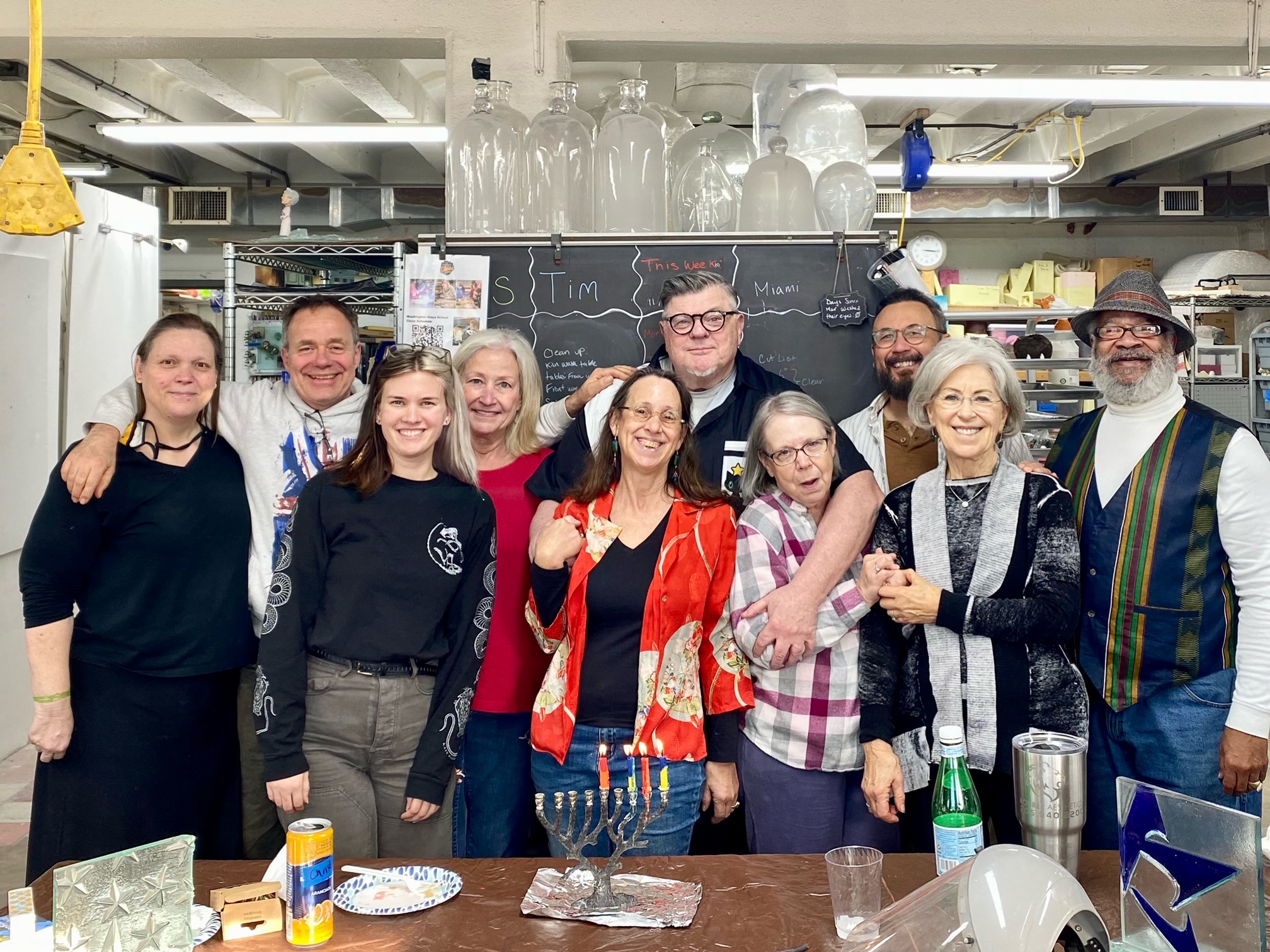
(L-R) Patricia De Poel Wilberg, Erwin Timmers, Christina Helowicz, Nancy Kronstadt, Kate Barfield, Tim Tate, April Shelford, Michael Janis, Trish Kent and John Henderson. Not pictured: Graciela Granek, Sean Robinson, Diane Cabe, Gabrielle Morris, Kyle Crosby, and Daphne Matyas.

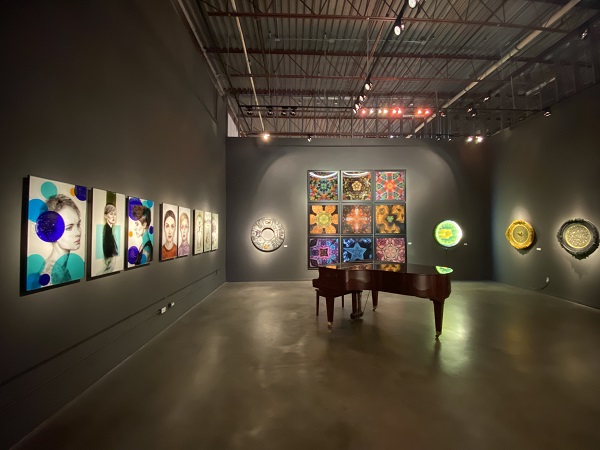
Janis & Tate @ Toronto’s Sandra Ainsley Gallery

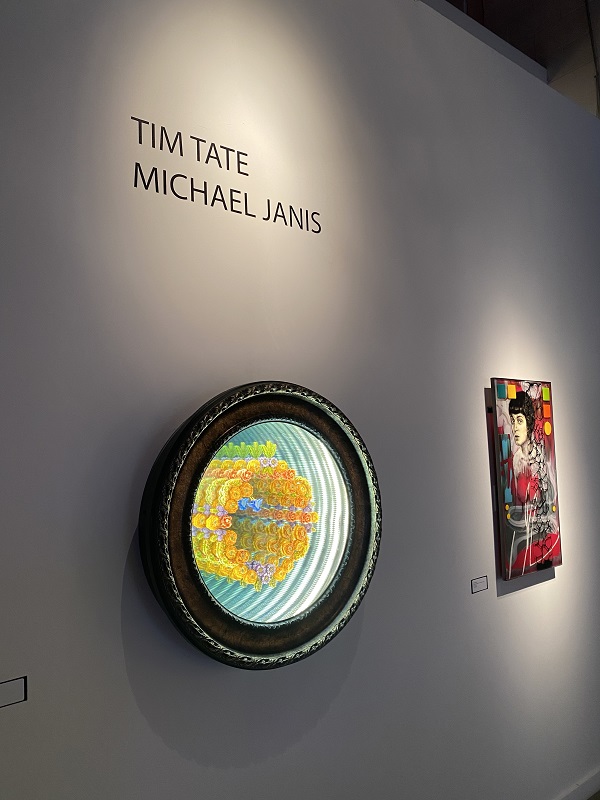
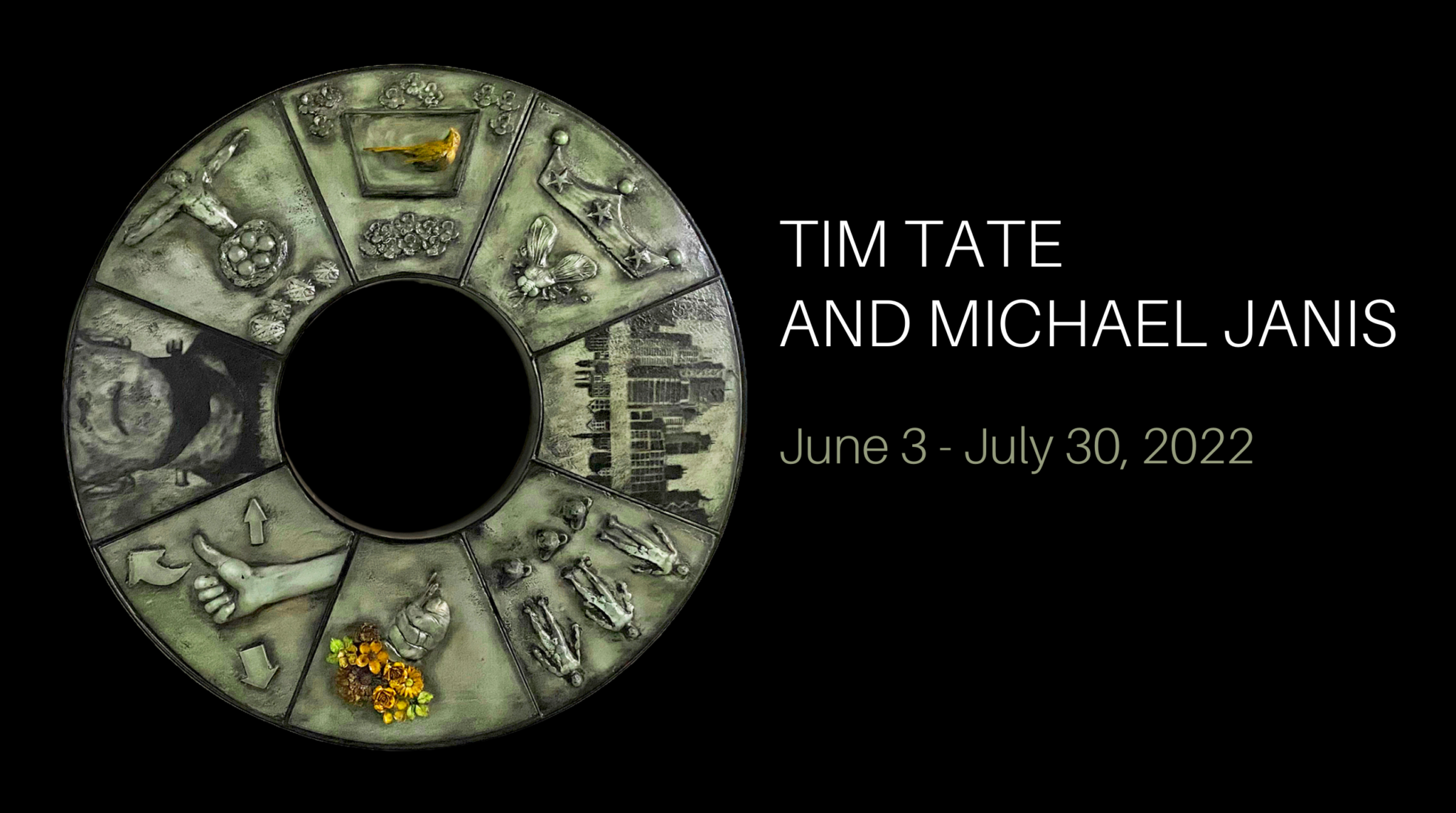
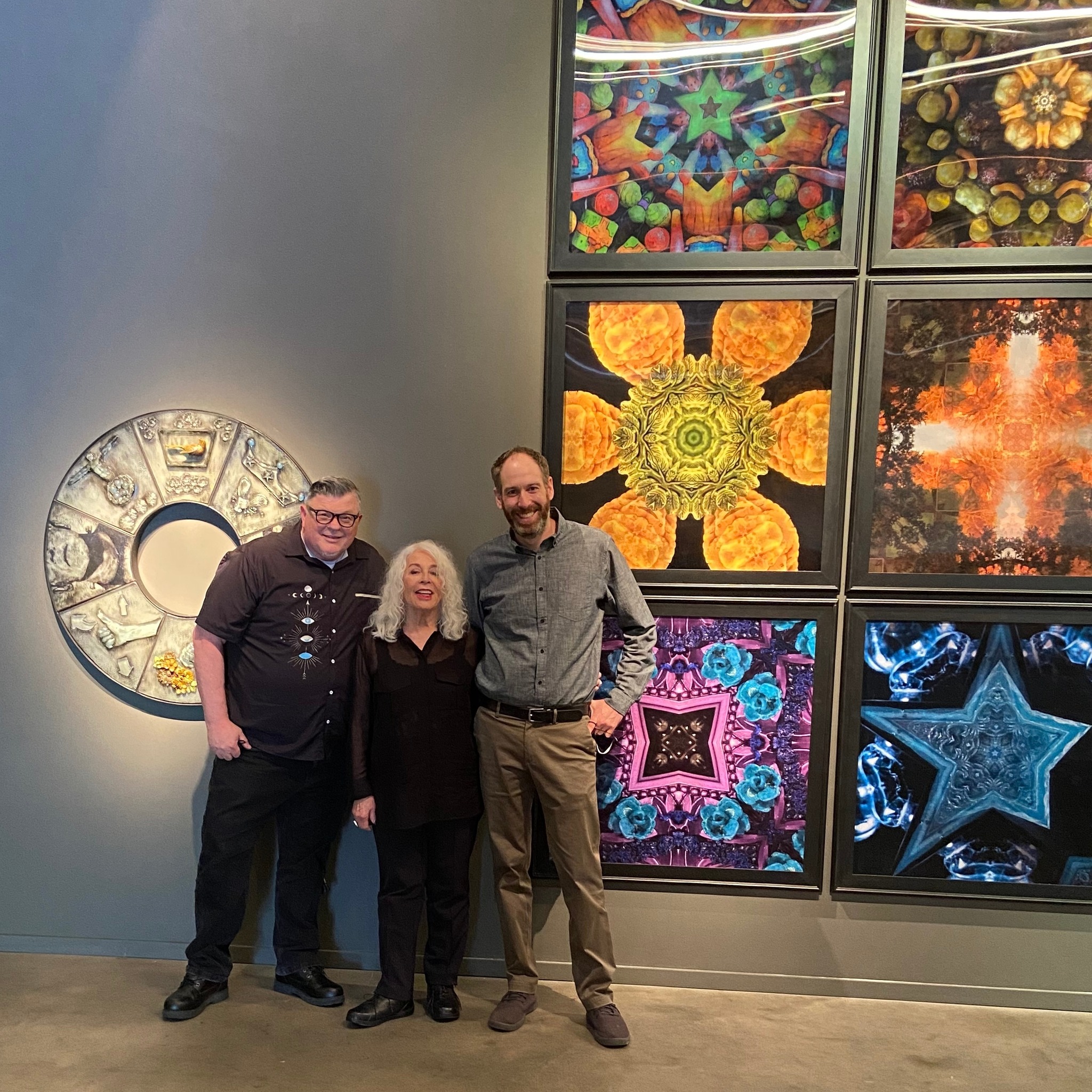
Michael Janis & Tim Tate at Toronto’s Sandra Ainsley Gallery June 4 – July 30, 2022

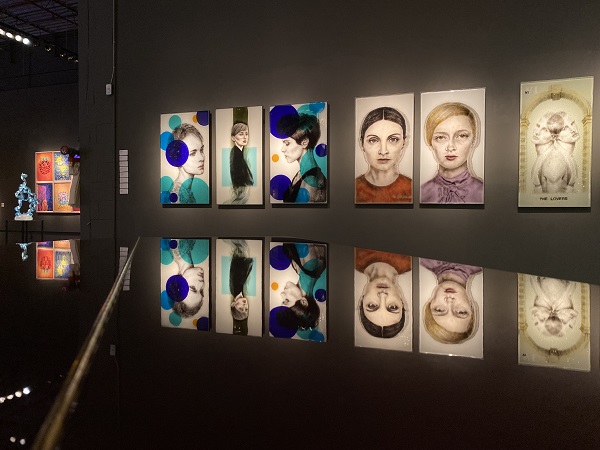
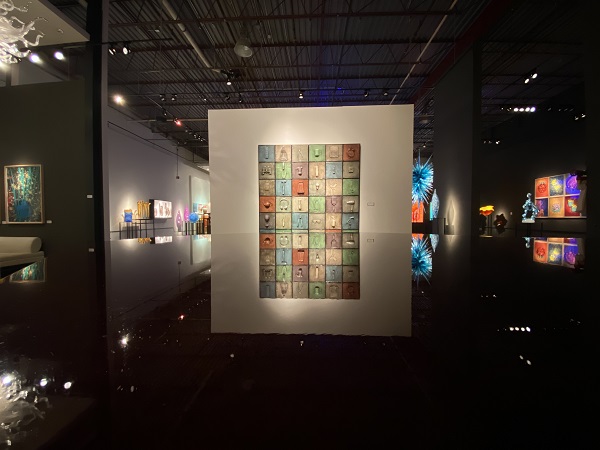
Toronto, Canada’s famed Sandra Ainsley Gallery present the narrative glass artworks by WGS Co-Directors Tim Tate and Michael Janis. The show, titled “One Story is Not Enough” featured works by each artist as a solo, and a number of their collaborative wall murals.

Michael Janis’ imagery in frit powder is reflected in the gallery’s piano surface.

When Michael Janis and Tim Tate met, almost 20 years ago, they discovered a shared fascination of narrative sculpture- one that seeks to arrive at an image that is both unflinchingly candid in physical representation and psychologically evasive. Working together, they are interested in the simultaneous read of an immediately recognizable image that asks the viewer to linger over history and meanings that unfurl more slowly. Mark, line and material become an extension of touch in the act of representation. The relationship of hand to subject, negotiated through the material, can elicit a response of both visual and tactile.

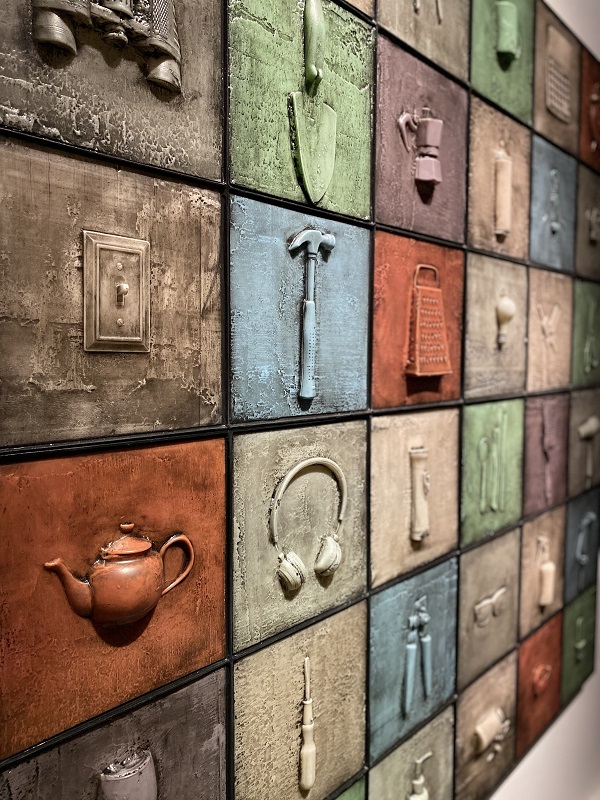
“The Poetry of Everyday Objects” by Michael Janis & Tim Tate, 2021; Size:6H x 6W’; Cast Glass

With these confines they create work in many techniques, but if you stand slightly back and see their history a huge thread of interconnected stories weave through their work from day one. The beauty comes into focus and the viewer sees the edges of a world not dissimilar to this one, but so much more thoughtful.

Detail – “The Poetry of Everyday Objects”, Michael Janis & Tim Tate

They present this glimpse into that alternative world, seemingly unstuck in time somewhere between past and future.

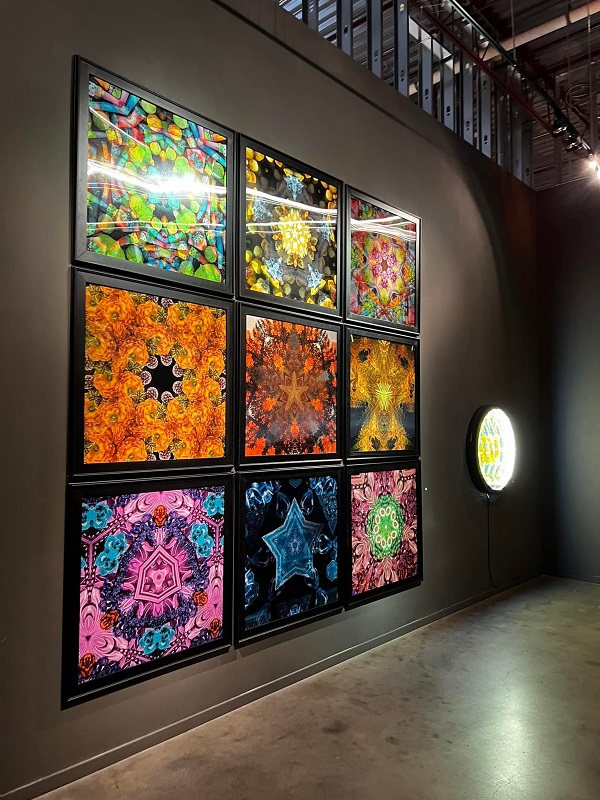
Tim Tate, Lenticular series, 2022, each panel 41″H x 41″W, lenticular prints

Sandra Ainsley Gallery
The Warehouse
100 Sunrise Avenue, Unit 150
Toronto, Ontario Canada M4A 1B3