WGS at 25: Cheryl P. Derricotte — People, Politics, Place & Glass

As the Washington Glass School celebrates its 25th anniversary, we’re looking back with the artists who helped shape its earliest years—and whose own practices grew alongside the School.

artist cheryl derricotte works in her studio as a resident artist at washington glass school, circa 2009
Cheryl Derricotte in her studio space at the Washington Glass School, circa 2009

Cheryl P. Derricotte was there almost from the beginning.

Originally from Washington, DC, Cheryl came to glass after studying ceramics and sculpture at the Corcoran School of Art. What began with the confident assumption that making a glass bowl couldn’t be that different from throwing one in clay quickly turned into something much bigger: a new material, a new artistic language, and ultimately a lifelong practice.

Today, based in San Francisco, Cheryl works across glass, paper, textiles, and public art. Her research-driven work explores history, race, memory, power, identity, and place—using art to create what she calls a “brave space” for conversations that can be difficult, necessary, and transformative.

For WGS’s 25th anniversary, we caught up with Cheryl to talk about those earliest days at the School, finding her place in the larger glass community, the importance of representation and historical truth, and why glass still has the power to make her wildest dreams come true.

Beginnings

WGS: You were one of the first studio artists at Washington Glass School. What do you remember about those early days, and what drew you to become part of the community?

Cheryl P. Derricotte: I always say that I came to glass from arrogance!

In 2002, I was finishing a certificate in Ceramics and Sculpture at the former Corcoran Museum’s College of Art and Design, shortly after the Washington Glass School opened. I thought, “If I can throw a clay bowl, I can make a glass bowl—no problem!”

Glass got the last laugh, as it always does, as I barely finished my first glass bowl by the time everyone else had finished two!

The next glass class I took was a lighted sculpture course. I found my calling and continued to fall in love with glass.

washington glass school class with students working on projects, circa 2009
Workshop at Washington Glass School, circa 2009. L-R Cheryl Derricotte, Dave Cool, Nicole Puzan.

WGS: Looking back, how did that early studio environment influence your artistic voice?

CPD: From its inception, the Washington Glass School was equally interested in the visual storytelling properties of glass practice as well as bringing finely crafted contemporary art into the world.

This tandem focus was a great environment for me to combine my activist voice with a new sculptural practice in glass.

Cheryl Derricotte at opening of exhibit at Foundry Gallery, DC in April, 2009.

WGS: Was there a particular moment at WGS that changed the way you thought about yourself as an artist?

CPD: When co-Director Tim Tate suggested I go to the Penland School of Craft to study with Therman Statom—the most famous Black glass artist on the planet, who was also from Washington, D.C.—I began to see that there might be a place for me in the larger glass community.

I should also note that during that trip to Penland, I met Washington glass artist Jeff Zimmer. Upon our return, we had a standing “Tuesday Studio Date Night” that furthered my practice.

The studio was in a remote location in those days, so having an artist-buddy who would walk me to the Metro to go home on Tuesday nights was wonderful. I am forever grateful to Jeff for his friendship in those early days of our careers.

Material & Meaning

WGS: Glass remains at the heart of your practice, even as you’ve expanded into paper, textiles, and public art. What continues to draw you back to glass?

CPD: I love working with glass, as it has the most expansive interplay of color and light of all the mediums, in my opinion.

WGS: Your work often explores identity, memory, and social history. When did you realize those themes would become central to your practice?

CPD: In the first sculptural workshop I took at Washington Glass—a lighted glass sculpture class—I decided to make a work about global poverty entitled Shed Some Light.

So, very early in my career, I was exploring my contemporary political concerns through my art practice. These concerns have continued to this day.

WGS: How do you decide which material is best suited to tell a particular story?

CPD: In my own work, I always reach for glass when the subject is portraiture, as I enjoy being in conversation with the history of photography, specifically daguerreotypes.

“Freedom’s Thresholds” sculpture unveiling ceremony, Gateway at Millbrae Station, 2023. The artwork contains more than 30 glass tiles. (Photo: Bevan Duffy/Twitter)

Public Art & Community

WGS: Your recent public commissions invite people into conversations about history, belonging, and shared space. What have you learned about making art for communities rather than galleries?

CPD: My public art commissions have allowed me to make work at a larger scale that will resonate with a wider audience.

I enjoy the fact that public art is free for anyone to view, and I have been fortunate that my sculptures to date have been placed in spaces with high pedestrian interaction.

WGS: How is designing a permanent public artwork different from creating a studio piece? What have you learned about balancing artistic vision with collaboration?

CPD: There are a lot of cooks in the kitchen of public art!

While I create the vision and overall design of a piece, there can be layers upon layers of opinions and reviews by community groups, nonprofits, and government agencies.

While sometimes this is more challenging than others, I consistently enjoy the partnerships I develop with metal fabricators to realize sculptures centering glass at a monumental scale versus a gallery-wall scale.

This combination of enjoying making the work and knowing that ultimately it will be free for anyone to see is what has kept me coming back to public art practice.

WGS: Projects like Freedom’s Threshold honor individuals whose stories continue to resonate today. What responsibility do artists have when interpreting history through public art?

CPD: Even though it is a big word, I stand on truth.

My research-based practice extends to my public artwork, as I use critical biographies and first-person interviews if available.

I have found that most of the historical figures I have worked with in my art practice—Harriet Tubman, John Brown, Mary Ellen Pleasant, James and Sally Hemings, to name a few—have interesting factual stories for me to tell without succumbing to mythology or sensationalism.

I often look at historical news stories as well, and sometimes they were highly sensational!

Detail “Freedom’s Threshold” (Photo Credit: Padma Maitland, PhD)

The Artist’s Journey

WGS: Your career has taken you from Washington, D.C., to San Francisco, with work now reaching audiences across the country. Looking back, what experiences most shaped your path?

CPD: Growing up in Washington, D.C., I was aware that I lived in the last colony on the mainland of America. So, it was always important to me to learn what a state was and how it worked.

Going to school in New York, living for a while in Washington state, and ultimately my life in California gave me this knowledge.

These experiences also taught me how to travel, and as an artist this skill has helped me immensely! I am very comfortable with moving my body and/or my art to locations across the country and, increasingly, in Europe.

Cheryl Derricotte working at the Studio at Corning (Photo: Jeffrey Foote Photography)

WGS: Is there a project that surprised you by changing your own perspective as you made it?

CPD: In 2022, I was invited by HABATAT to do an online solo show as part of its Not Grandma’s Glass exhibitions.

I made a series of work entitled Glass Boys: Portraits from America’s Factories that centered Black children working in glass factories—including those in Alexandria, Virginia—in the 1920s.

While Tim Tate understood that representation mattered and wanted me to meet Therman Statom right away in the early days of Washington Glass, working on the Glass Boys series allowed me to understand that I was part of a much longer lineage of Black glass artists.

Since creating this work, I have also seen images of Black women working in the factories. I keep an image in my studio of a Black woman holding a mold on the hot-shop floor that someone sent me after seeing my series.

Two pieces from my Glass Boys series were exhibited as part of the groundbreaking exhibition A Two Way Mirror: Double Consciousness in Contemporary Glass by Black Artists, curated by Jabari Owens-Bailey for the Museum of Glass.

The exhibition is currently on tour and can next be viewed at the Wichita Art Museum, January 16–June 6, 2027.

WGS: What role did Washington Glass School play in your development as an artist?

CPD: Washington Glass School introduced me to the medium that has been a constant companion in my art practice over the last 25 years.

WGS: What made the community at WGS different from other studios you’ve worked in?

CPD: Washington Glass School’s commitment to the narrative qualities of glass, and to glass as a sculptural medium, distinguishes it from other studios.

WGS: What do you think has allowed Washington Glass School to thrive for twenty-five years?

CPD: Washington Glass School has thrived for twenty-five years because of its attitude toward competition: A rising tide floats all the boats.

It is one of the most supportive places for artists, as Tim, Erwin, and Michael genuinely want everyone to do well!

artist cheryl derricotte visits washington glass school in the days before the covid lockdown.
2020 visit to Washington Glass School. L-R Cheryl Derricotte, Michael Janis, Tim Tate, Nancy Kronstadt, Teri Swinhart, Erwin Timmers.

Looking Ahead

WGS: What subjects or ideas are you most excited to explore in the years ahead?

CPD: I have three long-term projects that were originally started on residencies, and I am excited to bring them to fruition!

Having recently finished the bulk of the work with support from the Howard Foundation and a generous anonymous donor, my conceptual glass portraits of James and Sally Hemings are hopefully going to be exhibited in late 2027 or early 2028.

I am continuing my work about an Indigenous California tree, the Desert Fan Palm, which has more oases in Joshua Tree than anywhere else in North America.

I am also continuing my work on the bison who live on islands in the U.S.—in Alaska, California, and Utah.

Nothing would make me happier than reporting that all three of these projects have been completed and exhibited by 2030!

Cheryl Derricotte, “California Trees”, (Photo: Keay Edwards)

WGS: How do you hope artists will continue to push the boundaries of glass as a contemporary art medium?CPD: I hope that artists continue to look for ways to exhibit glass in all the places—contemporary art galleries, libraries, public art—not just medium-specific galleries and museums.

WGS: What advice would you give to emerging artists who want to build meaningful, socially engaged careers?

CPD: The most important thing you can do is decide what interests you and pursue it unapologetically!

When people look at my work, it doesn’t matter if it is a historical Black figure, a house, a tree, or a bison—there is a through-line of people, politics, and place that is immediately recognizable.

Closing Reflection

WGS: If you could revisit your younger self in the Washington Glass School studio twenty-five years ago, what would you tell her?

CPD: On the practice side, I would tell my younger self to prioritize getting her own equipment sooner rather than later.

On the visionary side, I would tell my younger self that glass is the thing that will make your wildest dreams come true.

WGS: As Washington Glass School celebrates its 25th anniversary, what are you most proud to have been part of?

CPD: I am so proud to have been in Tim Tate’s living room when the conversation about the structure for the School was taking place.

I was the one who explained all of the challenges of being a nonprofit and suggested that the School remain an LLC and work with fiscal sponsors when needed.

Ultimately, this decision served the Washington Glass School, and later the Washington Glass Studio—the public-art arm—very well, while preserving the co-directors’ control and vision.

WGS: Your work often creates spaces for reflection, dialogue, and healing. What do you hope people carry with them after experiencing one of your artworks?

CPD: I work intuitively, so seemingly random observations of current events and landscapes—including the political ones—often lead me to the economic and environmental concerns that guide my art practice.

Historical portraits and stories weave through my wall work and sculptures. My recurring themes are home, memory, place, and spirit.

When people view my work, I always want them to be intrigued to learn more about the topic and have conversations about it.

I believe that the gallery and museum are the brave spaces to hold difficult conversations.

Art is the perfect vehicle to lead us into the kind of discussions we would prefer to avoid—and bring us out on the other side in a place of deeper understanding and connection.

Twenty-five years after Cheryl first discovered that glass was considerably less cooperative than clay, that stubborn material remains her “constant companion.”

From Shed Some Light to Glass Boys, from intimate portraiture to monumental public commissions, her work embodies an idea that has been central to the Washington Glass School from its earliest days: glass can do more than demonstrate technique. It can carry narrative, recover history, provoke conversation, and connect people.

And perhaps Cheryl’s own journey offers the perfect anniversary reflection: sometimes the material that humbles you at the beginning turns out to be the one that makes your wildest dreams come true.

Call for Entries: 12th Annual Workhouse Glass International

Deadline for Entries: September 14, 2026

The Workhouse Arts Center has announced its “Call for Entries” for the 12th Annual Workhouse Glass International Exhibition.

This is an Open Call for functional and/or sculptural glass artworks for this anticipated annual exhibition demonstrating the breadth of contemporary glass. All levels are welcome.

JUROR: Corey Pemberton (American b. Reston, VA, 1990) received his BFA from Virginia Commonwealth University in 2012. He has completed residencies at The Pittsburgh Glass Center (PA), Bruket (Bodø, NO), Alfred University (NY), as well as a Core Fellowship at the Penland School of Crafts (NC). He has exhibited work at the Robert and Frances Fullerton Museum of Art (CA), The Contemporary Museum of Art in Raleigh (NC), and has work in the permanent collections of The Museum of Art and Design (NY), The Boston Museum of Fine Art (MA), and The Chrysler Museum of Art (VA). Pemberton currently resides in Los Angeles, California where he splits his time between the nonprofit arts organization Crafting the Future, painting, and his glass practice.

Exhibition Dates: October 24, 2026 – January 3, 2027

apply and learn more – click HERE

Celebrating 25 Years of Glass & Community

The Washington Glass School celebrates 25 years with a special exhibition at Brentwood Arts Exchange showcasing the artists, educators, and community that shaped its legacy.

In 2026, the Washington Glass School marks a major milestone—25 years of artists, ideas, and community.

To celebrate the anniversary, the Brentwood Arts Exchange will present a special exhibition from September 10 through October 31, 2026, with an opening reception on Saturday, September 19. The exhibition brings together many of the artists who have helped shape the Washington Glass School over the past quarter century, including founders, resident artists, instructors, and alumni.

Founded in Washington, DC in 2001 and based in Mount Rainier, Maryland since 2006, the Washington Glass School has grown into a vibrant center for contemporary glass and mixed-media art. Over the past 25 years, nearly 6,000 students have studied at the school, creating a dynamic community that continues to expand through teaching, exhibitions, public art commissions, and artistic collaboration.

Rather than focusing on a single style or technique, the exhibition reflects the remarkable diversity of artists connected through the school. Visitors will see work ranging from kiln-formed and cast glass to sculpture, installation, architectural glass, and mixed media—demonstrating the many creative paths that have emerged from the Washington Glass School.

The exhibition celebrates not only the artwork, but also the people and relationships that have defined the school for 25 years. We hope you’ll join us at the Brentwood Arts Exchange this fall as we celebrate the artists, friendships, and creative community that continue to make the Washington Glass School a unique place to learn, create, and grow.

Washington Glass School: 25 Years
September 10 – October 31, 2026
Opening Reception: Saturday, September 19, 2026
Brentwood Arts Exchange
3901 Rhode Island Avenue
Brentwood, MD 20722

WGS Resident Artist Spotlight: John Henderson, Jr.

“The rhythm of the drum…

For Washington Glass School resident artist John Henderson, Jr., working with glass is both a creative pursuit and a spiritual practice. Since discovering kiln-formed glass at WGS, he has embraced the material’s beauty, technical challenges, and inherent unpredictability.

Discovering Glass

John’s introduction to Washington Glass School came while taking a stained glass class in the shared building that housed both the Washington Sculpture School and WGS.

“I had never worked with fused glass before,” he recalls. “As a result of taking a class at WGS, I became hooked on the process.”

What first attracted him was glass itself—its remarkable range of colors and textures, and the technical possibilities it offered. But it was something less tangible that kept him coming back.

“I enjoy working with my hands and creating beautiful objects,” he says. “The material has a spiritual quality due to its unpredictability when fire is applied. Not knowing the outcome is, in itself, stimulating and emotional.”

John Henderson “Warrior Shield”

Finding a Voice

Early in his artistic journey, John recognized something significant: very few Black artists were working primarily in glass.

Black Artists of DC (BADC) visit John Henderson’s studio space, October 2025. L-R Sharon Robinson, Jimmy James Green, Evalyn Hamilton & John Henderson at his studio in WGS.

“Glass as an artistic medium was not an established art form within the African American community,” he explains.

As his practice developed, opportunities followed—including exhibiting work, organizing exhibitions, and becoming an active member of the Washington Glass School community. Those experiences helped shape both his artistic direction and his commitment to expanding representation within the field.

John Henderson installs his work in the WGS Gallery.

The Value of Community

For John, one of the greatest strengths of Washington Glass School is the environment created by artists working together.

“I find working in a shared environment stimulating,” he says. “Sharing information with fellow artists, exchanging ideas, and participating in constructive conversations continues to influence my work.”

That collaborative atmosphere, he believes, is one of the things that sets WGS apart.

“There is no other facility in the DMV that provides a collective space for practicing artists whose primary medium is glass.”

Looking Ahead

As Washington Glass School celebrates its 25th anniversary, John reflects on being part of its continuing story.

“It is an honor and privilege to be a studio artist at WGS,” he says. “WGS has evolved into an artistic and educational center for everything having to do with the practice and techniques of using glass as an artistic material.”

His hope for the future is straightforward and ambitious:

“That Washington Glass School will be known as one of the premier glass centers in America.”


One More Question

If your work had a soundtrack, what would be playing?

“The rhythm of the drum.”

As Washington Glass School marks its 25th Anniversary, the celebration continues this fall with a major exhibition featuring works by Washington Glass School artists at the Brentwood Arts Exchange in Brentwood, Maryland. Running from September 10 through October 31, 2026, the exhibition will showcase the extraordinary diversity, innovation, and storytelling that have defined the School for a quarter century — offering audiences a chance to experience some truly remarkable contemporary glass art.

The exhibition opening reception will be held on September 19, 2026, bringing together artists, friends, collectors, students, and the larger arts community in celebration of 25 years of Washington Glass School. An artist talk is scheduled for October 17th, 2026.

“WGS Is Home” — A Conversation with Jeff Zimmer

Washington Glass School at 25

Jeff Zimmer demonstrating his technique at North Lands Creative Glass, Scotland, 2018.

Jeff Zimmer was one of the earliest resident artists at Washington Glass School, working out of the original Half Street SE studio in the early 2000s. Since then, his career has taken him internationally — from earning his MDes s at Edinburgh College of Art to exhibiting in the British Glass Biennale and having work acquired by museums including the Victoria & Albert Museum in London.

For Washington Glass School’s 25th Anniversary, Jeff reflects on finding his voice, building community, and why WGS still feels like home.


On his first memories of WGS

Ca 2004 photo of Jeff Zimmer’s workspace at 1338 Half St, DC.

“My first memory of WGS is helping carry rolls of old carpeting down endless corridors to clear the original Meltdown studio site.

I had only been working with glass for a few years, and Tim brought me on to assist classes — even though sometimes I was learning something only minutes before the students!”

Later, as one of WGS’s first resident artists, Jeff spent countless nights cycling to the Half Street studio after work, often staying until midnight.

“The first works I really consider to have my own voice came out of that time.”

Jeff Zimmer, “Untitled Political Landscape“, 17 layers of enameled & sandblasted glass, lightbox, 2008

“WGS felt like it didn’t participate in hierarchy. I felt supported to pursue my own path.”


On finding his artistic voice

“At the time, I perceived the glass world as very hierarchical — dominated by glassblowing, with painting on glass seen as secondary or decorative.

Now, I love glassblowers and beauty, but that’s not my voice.”

What Jeff found at WGS was freedom to explore ideas outside those expectations.

Jeff Zimmer, “The Wake of The Hero“, layers of enameled glass, assembled in lightbox, collage, 2011

“There was already a concern with complexity and ambivalence in the work I was making then. That has stayed with me ever since.”


On thinking through glass

“As the years progress, I realize I think more and more through the material itself — not only its techniques, but its associations.”

For Jeff, glass carries centuries of layered meaning.

“I can draw on medieval associations of light and virtue reflected in stained glass, ideas of transparency and opacity, glass as both window and barrier, fragility and strength — even the ‘black mirror’ of our screens.”


“Ideas don’t really exist for me until I can find a way for them to exist in glass.”


On teaching and exchange

Jeff has taught internationally at Pilchuck, Bild-Werk Frauenau, Berlin Glas, and other institutions, while co-running Glass Lab Edinburgh in Scotland.

“Different glass communities shape artists in very different ways,” he says.

He notes how Germany’s technical school traditions, the UK’s emphasis on casting and painting, and resourceful studio cultures in South Africa and Latin America all create different relationships to the material.

“When those communities meet internationally, there’s a real exchange. That’s where things become interesting.”


On teaching beyond technique

“Technique matters, but it’s not the point.

I want students to use technique to find their own voice. The best moment is when you see someone take a process and immediately run somewhere unexpected with it.”

Teaching, he says, has also sharpened his own practice.

“It forces me to break instinct down into conscious steps.”

Jeff Zimmer chats about artist Audrey Wilson’s concept.

“The barriers to working in glass are high. Having a place that supports experimentation early on can completely change what becomes possible for someone.”


On success, recognition, and reality

Despite international awards and museum acquisitions, Jeff speaks candidly about the realities of sustaining an artistic practice.

“Some of the times I’ve had the most apparent ‘success’ were also the times I was supporting myself as a 45-year-old cycle courier.”

Recognition can help open doors, he says, but often quietly.

“The V&A acquired a piece of mine, and it sat in storage for nearly a decade before going on display. For most of that time, its biggest visibility was on my CV.”

Jeff Zimmer won the top prize at the 2019 British Glass Biennale, part of the International Festival of Glass, in Stourbridge

On returning to Washington Glass School

“How does WGS fit into my journey? It came into my life at exactly the right moment.”

Jeff Zimmer and WGS Founder Tim Tate.

More than two decades after leaving DC, Jeff says returning to WGS still feels deeply personal.

“WGS is home.

Whenever I walk through the door, I feel embraced like family. There’s warmth, curiosity, generosity — that hasn’t changed…I’m proud of what you’ve built. And I’m grateful it’s still a place I can come home to.”


As part of the Washington Glass School’s 25th Anniversary programming, Jeff Zimmer returns this summer to teach a special intensive workshop:
5701 – Obscuring and Revealing
July 13–17
This five-day masterclass explores layering, transparency, dimensionality, and painted imagery in glass. Students will create personal three-dimensional layered compositions using glass painting techniques, collage, and spatial construction to investigate how glass can simultaneously conceal and reveal.

Washington Glass School Joins ACC’s National Craft Open Studios Weekend

Graphic announcing Washington Glass School hosting an open studio event for the American Craft Council's National Craft Open Studios Weekend on Saturday July 18 and Sunday July 19, 2026, between 12 PM and 5 PM.

Ever wondered what happens behind the scenes in a working glass art studio? This July, the public is invited inside.

The American Craft Council (ACC) launches its inaugural National Craft Open Studios Weekend on July 18–19, 2026, from 12 PM–5 PM local time. Part of the nationwide Handwork 2026 initiative, the free event connects visitors directly with more than 1,500 craft artists, studios, and creative spaces across 36 states and Washington, DC.

Think of it as an “Independent Bookstore Day” for American craft — a rare opportunity to step into the spaces where artists actually make the work.

As an official participating studio, the Washington Glass School will open its doors during this national celebration of handmade culture. The event also arrives during WGS’ 25th Anniversary year, making it the perfect time to experience one of the DC region’s leading centers for contemporary glass art.

Visitors will be able to:

  • Explore the Washington Glass School’s working studios and specialized glass facilities
  • See firsthand how kiln-cast glass, fusing techniques, and glass-and-steel artworks are created
  • Meet resident artists and instructors
  • View works in progress and hear directly from the makers
  • Purchase original contemporary glass artworks, sculptures, and panels

More than a traditional open house, the weekend offers a chance to experience the energy, experimentation, and craftsmanship that happen inside an active arts community.

The event also extends beyond the school itself. WGS is coordinating open hours with neighboring creative spaces along the corridor, creating a walkable destination for DMV art lovers. Visitors can also explore nearby studios including Ampersand Art Space and Tyler Makes Things.

Whether you are a collector, artist, student, or simply curious about how things are made, this weekend offers a unique opportunity to experience the creative process up close.

washington, dc and maryland makers of contemporary craft at Washington Glass School, promoting the American Craft Council (ACC) inaugural National Craft Open Studios Weekend happening July 18–19, 2026, 12 PM–5 PM.

Event Details

Washington Glass School3700 Otis St. Mt Rainier, MD 20712
July 18–19, 2026
12 PM – 5 PM
Free and open to the public

Come see where heat, glass, steel, and imagination meet.

Register for free at the link below, or contribute to the nonprofit American Craft Council with a recommended donation of $10.

National Craft Open Studios Weekend – American Craft Council | American Craft Council

Fort Wayne Museum of Art’s 54th Annual International Glass Invitational

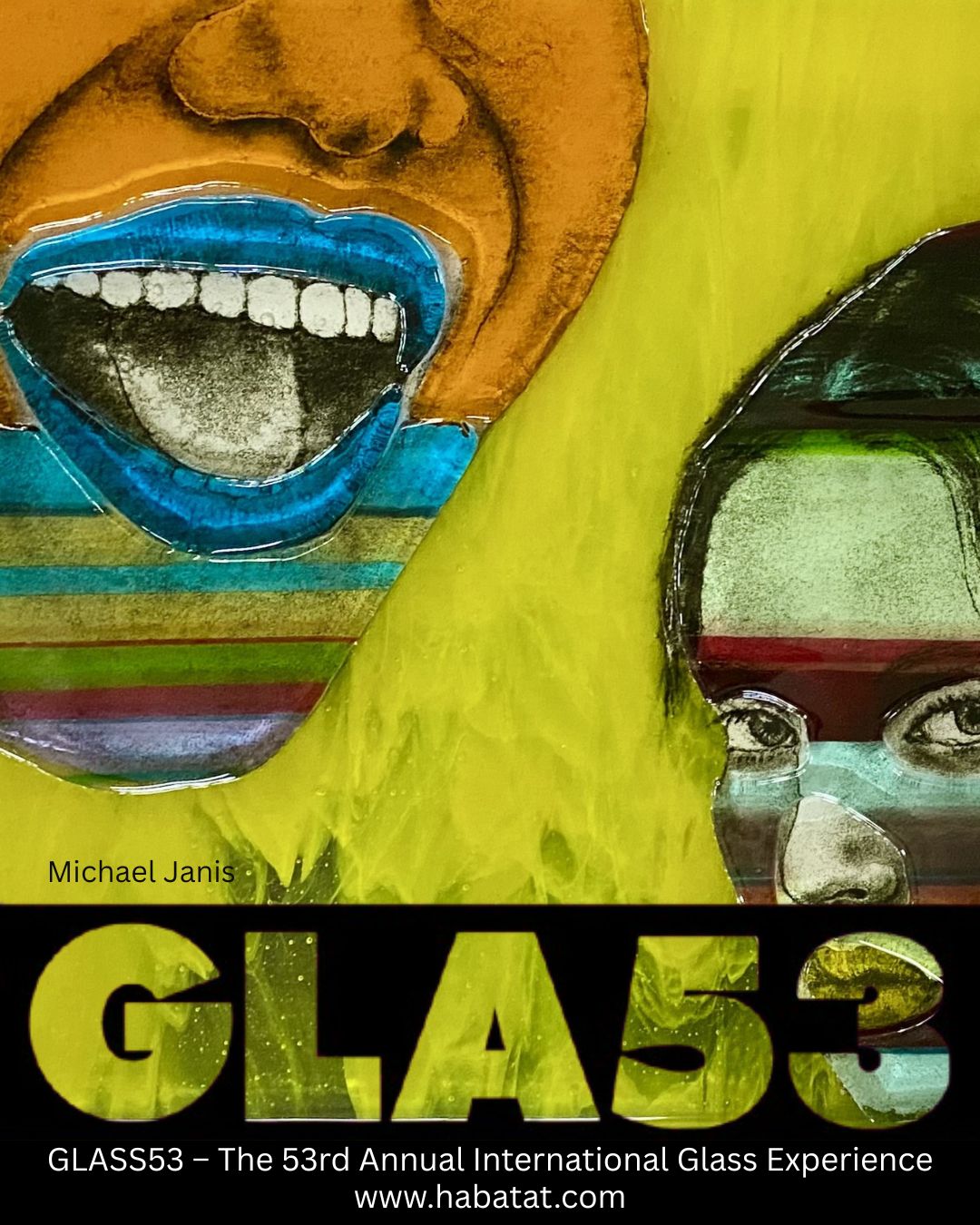
The Fort Wayne Museum of Art’s annual Summer of Glass exhibition returns this season with the opening of the Habatat International Glass Invitational, now in its 54th year and recognized as the oldest and largest annual contemporary glass exhibition in the United States.

Presented at the Fort Wayne Museum of Art in Indiana, the exhibition gathers leading contemporary glass artists from around the world whose work expands the possibilities of the medium through new forms, techniques, and ideas. Organized by Habatat Galleries, the invitational has long been regarded as one of the major surveys of international studio glass.

Michael Janis figurative glass artwork “A Secret Place I Go” displayed in the Summer of Glass exhibition at the Fort Wayne Museum of Art, featuring contemporary studio glass artists from around the world.

Among the artists selected for this year’s exhibition is Washington Glass School Co-Director Michael Janis, whose cast glass artwork A Secret Place I Go was chosen for inclusion in the juried exhibition.

Janis’ work — known for its layered figurative imagery, narrative complexity, and technically innovative kiln-formed glass processes — continues his exploration of memory, identity, and psychological space through contemporary glass art. The selected piece reflects the artist’s signature approach of combining sculptural depth with painterly imagery embedded within translucent glass.

Cast glass wall artwork by Michael Janis shown in the Habatat International Glass Invitational, highlighting innovative contemporary studio glass techniques and figurative imagery.

The exhibition was juried by Brit Micho, Curator of Exhibitions at the Fort Wayne Museum of Art; James Gerhardt, AACG President and Guggenheim Museum Officer; and Sharon Karmazin, theater producer, arts supporter, and noted glass collector.

Exhibition gallery view of contemporary glass art at the Fort Wayne Museum of Art featuring work by Michael Janis in the 2026 International Glass Invitational.

Artists included in the 2026 exhibition represent an international cross-section of contemporary glass, including Lino Artists included in the 2026 exhibition are Rick Allen, Shelley Allen, Alex Bernstein, Michael Behrens, Geoffrey Bowton, Wendy Saxton Brown, Nancy Callan, Ekin Aytec & Josh Davids, Bandu Dunham, Philip Baldwin & Monica Guggisberg, Willfried Grootens, Michael Janis, Claire Kelley, John Kiley, Laura Kramer, Lucy Lyon, Crista Matteson, Stephen Powell, Toland Sand, Carrie Seid, Lino Tagliapietra, Sarah Vaughn, Littleton Vogel, Brent Kee Young, and Public Choice artist Trina Urrata Weintraub.

Museum installation view featuring contemporary glass artwork by Geoffry Bowton at the Fort Wayne Museum of Art.

Habatat Galleries co-owner and director Aaron Schey described the current moment in contemporary glass as a period of rapid growth and renewed energy:

“I think contemporary glass is experiencing a rebirth. The community is growing, new talent is appearing every day, and artists are sharing ideas and techniques in ways that were never possible before.”

Schey emphasized that increased museum visibility and public engagement remain essential to the future of the medium:

“Glass elevates every space it enters. It interacts with light, architecture, and the viewer in a way few materials can.”

The 54th Annual International Glass Invitational is on view at the Fort Wayne Museum of Art, 311 E Main Street, Fort Wayne, Indiana, from June 20 through August 23, 2026.

Michael Janis’ cast glass work A Secret Place I Go is now on view at the Fort Wayne Museum of Art as part of the 54th Annual International Glass Invitational, organized by Habatat Galleries.

About Michael Janis

Michael Janis is a contemporary glass artist, architect, educator, and Co-Director of the Washington Glass School in Washington, DC. His internationally exhibited artwork combines kiln-cast and pâte de verre glass techniques with figurative imagery influenced by printmaking, street art, and narrative painting. Janis’ work has been exhibited in museums and galleries worldwide and is included in numerous public and private collections.

Washington Glass School at 25: April Shelford Reflects on Community, Craft, and Co-Creating with Glass

As part of Washington Glass School’s 25th anniversary series, we invited artists, instructors, and longtime members of the WGS community to reflect on their experiences with the school and the role glass has played in their lives and work.

Artist April Shelford first encountered Washington Glass School through a Glass Lover’s Weekend workshop and later became a studio artist known for her fused glass work exploring color, rhythm, and pattern bar techniques. Before retiring from American University as Associate Professor of History, Shelford built an acclaimed academic career as an intellectual historian of early modern Europe and the Caribbean, earning national recognition for her scholarship and publications.

In the reflections below, Shelford writes about discovering glass later in life, the meditative qualities of studio practice, and the creative community that has sustained her through changing times.

april glass shelford winning honorable mention in glass art at opening of NCAGG exhibit at Gallery B bethesda, MD May 2, 2026
April Shelford at opening of NCAGG exhibit May, 2026

I don’t remember how I heard about Glass Lover’s Weekend, but I was casting about for things that my husband and I could do together. This was maybe a dozen years ago, and the whole weekend was obviously great. But what really struck me was when Tim Tate gave us a tour of the studio and introduced the class to one of the studio artists. She was making these beautiful baptismal fonts, and she looked right at me and said, “Glass Lover’s Weekend was how I started.”

Statements like that accumulate meaning in hindsight, of course—contingencies from which we construct just-so stories, so be warned about what you’re reading.

April Shelford assembling glass art into mold for “Summer” glass panel

Yes, both my parents were creative types, opening up worlds of possibilities for me: literary, musical, visual. But honestly, I never imagined that I’d end up devoting so much time to working with, exhibiting, and teaching fused glass after essentially two careers: one arc spanning my 20s into my early 30s in production and printing, graphic design and advertising; the other, three decades and counting as an academic historian.

That said, there were aspects of my family background and that first arc that inclined me to like fused glass. Working in printing, I came to appreciate what you can do with noisy machines. This made the semi-industrial processes—the chopsaw, the grinder, the sandblaster—appealing. Slicing up a pattern bar on the chopsaw, shaping pieces on the grinder—these things can get pretty tedious, but can also be very meditative.

I developed some skill and took real pleasure in graphic design, producing attractive and (I’m proud to say) readable, if not terribly original work. And my mother’s lessons in knitting, crochet, sewing, and embroidery—not to mention meticulous work as a fabric artist—made me value craft: learning about the materials you’re using, practice-practice-practice, and avoiding “good enough.”

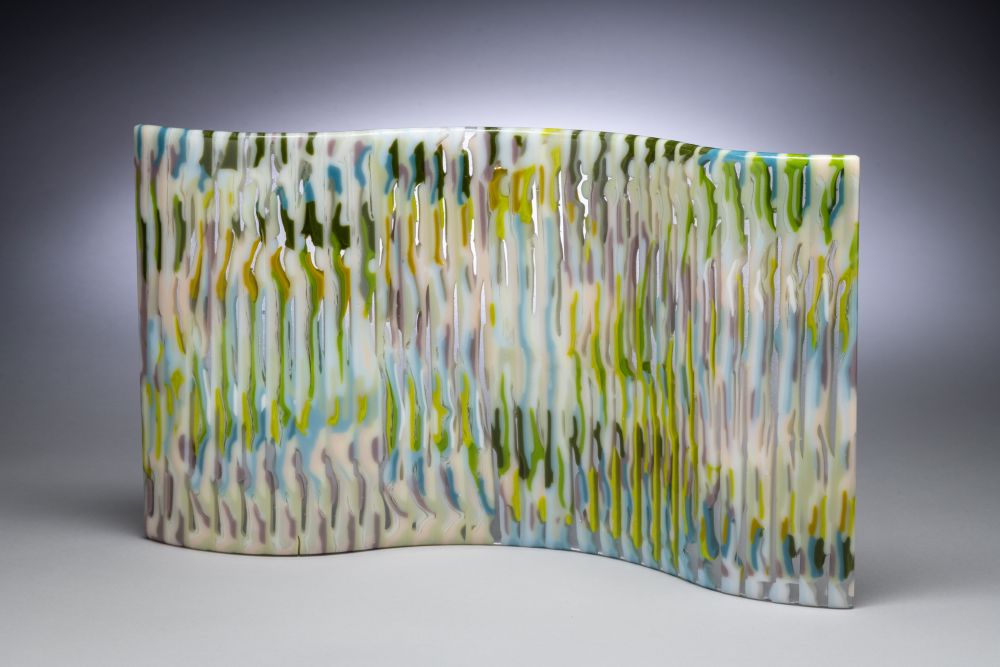
April Shelford “Catching The Wave”. Photo Pete Duvall.

Miscellaneous remarks, curiosity, and serendipity shaped my practice more than intentions once I’d become interested enough to take more courses and work more independently in WGS’s open studio. Years ago, for instance, Tim remarked that I have a good color sense. What’s color, but light reflected and transmitted? What does glass do but transmit and reflect color and light?

Free-form pattern bars struck me as a technique especially well-suited to experimenting with color and design, variety and rhythm. But whether working with pattern bar or other techniques, I wouldn’t have made much worth looking at if I hadn’t learned to set aside accidents and failures long enough to make the best of them.

There are ways to exert some control over a piece’s final appearance, but humility’s necessary because the results when the kiln’s opened are unpredictable given how glass flows. Some of those surprises are delightful; some, not so much. My best work happens when I’m co-creating with the glass, respecting rather than futilely attempting to dominate it.

April Shelford with her glass artwork “Fossil” at Women Artists of the DMV exhibit at McLean Project for the Arts, fall 2025

The secret sauce to my making (hopefully) good work is having more experienced folks around who are generous with good advice. First, there’s Michael, Tim, and Erwin. Despite their stature as real artists (unlike me!), I got the vibe early on that if I’m serious, they’ll take my questions seriously.

Then there are the other studio artists engaged in very different projects utilizing very different techniques whom I can always ask, “Does this work?” “What do you think?” “How did you manage that?”

So what’s WGS at 25 for me?

A creative community anchored by Tim, Michael, Erwin, the indispensable studio coordinator Arden Colley, other stalwarts like me, and folks who rotate in, out, and sometimes in again.

WGS kept me sane during the pandemic; it does the same now amidst our calamitous political culture and challenges like AI. Communities are complicated because people are. But occasional crankiness or tension aside, we cherish each other because we ultimately care about the same things:

Make beauty.
Make joy.
Make truth.

Women of WGS at opening of 10th Annual Glass International. L-R: April Shelford, Kate Barfield, Patricia de Poel Wilberg, Arden Colley.

Check out April Shelford’s IG page http://www.instagram.com/aprilglassshelford/!

The Experiment That Lasted 25 Years

Tim Tate co-founded the Washington Glass School to break every rule he’d inherited. A quarter century later, it’s still running — and so is he.

Washington Glass School in Mt Rainier, MD

The first thing you should know about Tim Tate is that he didn’t expect any of this to last.

When he and his co-founders — Michael Janis and Erwin Timmers — opened the Washington Glass School in the early 2000s, Tate gave the whole project maybe three years. He was running an experiment, not building an institution. The question driving it was deceptively simple: what would a glass school look like if it wasn’t tethered to the conventions of classic studio glass? Could it survive? Could it actually make something?

Twenty-five years and thousands of students later, the answer is self-evident.

Tim Tate circa 1999. (so young!)

Tate began his art career as a young HIV-positive queer man in the full, brutal heat of the AIDS crisis. He was the founder and director of the Triangle Artist Group in Washington, DC, and the director of the city’s first Art Against AIDS charity event — a benefit that raised funds for the newly established DC LGBTQ+ Community Center and the HIV-positive children’s ward at Washington Children’s Hospital. He was shaped by that community, trained in its values, fluent in its urgency. Civil rights and human justice weren’t themes he would later introduce into his work. They were the water he swam in from the beginning.

Tim Tate, “Two Paths Taken”, photo by Pete Duvall

That formation never left him. It structured how he thought about art, about purpose, and eventually about what a school could be.

_________________________________

The Washington Glass School was founded on a principle that sounds obvious but is, in practice, radical: everyone’s success is not achieved at the expense of anyone else’s. Tate had spent time in studios corroded by envy, watching artists diminish each other. He wanted something different. A rising tide, he believed, floated all boats — and so the school was built with that ethos embedded in its architecture.

Images from The Washington Post newspaper article about the Glass School, 2002. Photos by Mark Sypher.

The governance structure reflects the same logic. Tate, Janis, and Timmers operate as equal co-directors, each carrying a different set of responsibilities. When disagreement arises, they vote — and two out of three must agree. “We all had the same goal,” Tate says simply. “To keep the school alive and thriving.”

Washington Glass School directors in 2022, L-R the oh-so-handsome and super sexy compelling Michael Janis, Tim Tate and Erwin Timmers.
L-R Washington Glass School trinity: Michael Janis, Tim Tate, Erwin Timmers

That structure has held for 25 years. Not because there have been no disagreements, but because the underlying commitment was always shared.

_________________________________

The artistic agenda was never modest. Tate wanted to use electronics. Video. Wood, plastic, ceramics, paint. He wanted to find out what glass could become when it wasn’t required to stay within the boundaries drawn by 20th-century studio tradition.

Early on, he and William Warmus — the former curator of glass at the Corning Museum — founded a Facebook discussion group they called “Glass Secessionism,” a deliberate echo of Alfred Stieglitz’s Photo Secessionism movement. The name alone provoked. People were annoyed. Definitions were demanded. The two men eventually produced a 17-page warrant articulating what they meant.

Tim Tate and William Warmus reviewing artwork at Chicago art fair, 2014

Monica Moses, the then-editor of American Craft Magazine told them the controversy would be short-lived — that the ideas would simply become the norm. “And so it did,” Tate says now, with something closer to relief than triumph.

American Craft Magazine, April May 2014

Technology in his work, he explains, was never an end in itself. It was a tool. A metaphor. “A video was worth a thousand words” — an expansion of a single image, a way of deepening what glass alone could carry.

_________________________________

The work deepened alongside the politics. What had seemed to wane in the calmer early 2000s — the appetite for socially engaged art — came back hard as the political climate grew more charged. Today, one of Tate’s favorite classes to teach is called “Using Glass for Social Justice.” The curriculum, in a sense, is his biography.

Tim Tate, 12 Souls, 12 Resurrections, photo by Pete Duvall

His sculptures move through reliquary traditions and Victorian curiosity cabinets, through early cinema and the formal logic of Georges Méliès. They are blown and cast, embedded with video screens, built around found objects, animated by the tension between fragility and permanence that glass uniquely embodies. They hold names, poems, histories.

His piece Nine Future Supreme Court Justices imagines an LGBTQ+ legal future — nine figures, each identified, each carrying biographical weight. In Service, In Secret animates archival photographs of queer men and women in uniform, from the Civil War through World War II. When the Armor Becomes Wings places two glass figures in the act of shedding the armor of survival — one holding a crocus, one a red bird — beneath a blown glass dome crowned with a winged heart.

These are not decorative objects. They are arguments in glass.

_________________________________

The recognition has arrived steadily, and Tate wears it carefully. He has shown at the Venice Biennale exhibitions three times. He exhibited at the State Hermitage Museum in St. Petersburg before the Russia–Ukraine war made that world inaccessible. His work is held in the permanent collection of the Smithsonian American Art Museum and the Renwick Gallery. He designed the New Orleans AIDS Memorial.

New Orleans AIDS Memorial

He carries all of it back to DC deliberately. “I want DC and the glass school to be realized as major players in the art world,” he says. “It’s such a great city with astounding artists. I add what I can.”

_________________________________

Now comes the largest undertaking of his career.

Imagining Utopia: What Would America Look Like If It Were a Queer Accepting Country? is a major solo traveling exhibition that opens in September 2027 at the Katzen Arts Center at American University in Washington, then travels to the Lowe Art Museum in Miami, the Asheville Art Museum, and finally the Palm Springs Art Museum, where it runs through all of 2029. It is the kind of show that, as Tate acknowledges quietly, he couldn’t have imagined mounting a decade ago. He credits a seven-month collaborative relationship with the MacArthur Fellow Joyce Scott — an artist who works at the intersection of beadwork, performance, and social critique — as a turning point. Scott showed him the scale his thinking could reach.

Tim Tate, Charter of 36 Points of the LGBTQIA+ Bill of Rights, kiln cast glass, mixed media

The exhibition poses its question directly, without softening. It does not ask audiences to abstract the politics into aesthetics. It asks them to imagine — concretely — what a more accepting America would look like, feel like, be.

The piece The Common Thread, a six-foot collaborative cast glass tile wall made with Michael Janis, anchors the exhibition’s material ambition. The Resurrections series — which includes 12 Souls, 12 Resurrections — enacts a different kind of memorial, one that refuses finality.

Six-foot cast glass tile wall titled The Common Thread, collaborative artwork by Tim Tate and Michael Janis, presented as part of the Imagining Utopia exhibition. The work uses layered fused glass panels to explore collective memory and social justice themes alongside the Resurrections series (12 Souls, 12 Resurrections), which reframe memorialization through contemporary glass sculpture.
Tim Tate & Michael Janis, The Common Thread, 2026, 3′-0″ H x 6′-0″W, kiln cast glass, mixed media. Photo by Pete Duvall.

_________________________________

Ask Tim Tate what he’s most proud of that has nothing to do with his own artwork, and the answer comes without hesitation: Over 6,000 students in 25 years. A school that chose DC and that DC chose back.

Ask him what belief he’s completely reversed in 25 years: “That there is but one way to do anything. Everything has numerous paths.”

Ask him what he would do if he couldn’t make glass for five years: “I would become the world’s best pie maker.”

And ask him what would happen if that 25-year-old version of himself walked into the studio today — the young HIV-positive artist navigating the AIDS crisis, running benefits, learning to make things out of fire — and he pauses.

“He would probably start crying tears of joy.”

Stay tuned for exhibit updates!

_________________________________

The Washington Glass School celebrates its 25th anniversary this year, with a group exhibit at Brentwood Arts Exchange in Brentwood, MD. Tim Tate’s touring exhibition Imagining Utopia opens at the Katzen Arts Center at American University in September 2027.

Washington Glass School at 25: Welcoming Back Jeff Zimmer!

Jeff Zimmer, The Disconnect Between Action and Consequences (Drone 1)

As Washington Glass School celebrates its 25th anniversary, we find ourselves reflecting on the artists who passed through our studios and helped shape what this community has become. Some arrived as emerging makers searching for a new language in glass. Others helped define the adventurous spirit that has long distinguished the School. Few embody that journey more completely than Jeff Zimmer.

Before his work entered the collections of major museums and international exhibitions, Jeff Zimmer was one of the early artists working alongside Washington Glass School during its formative years. Originally trained in theatre in Washington, D.C., Zimmer brought with him a storyteller’s sensibility—an understanding of staging, atmosphere, and the emotional charge created by light, distance, and ambiguity.

That instinct eventually led him to glass.

Jeff Zimmer working in the WGS studio circa 2017.

Zimmer later earned a Master of Design degree in Glass & Architectural Glass from the Edinburgh College of Art in Scotland, developing a practice that has become internationally recognized for expanding the possibilities of glass painting. Today, his work can be found in prestigious collections including London’s Victoria & Albert Museum, the European Museum for Modern Glass in Germany, and the Museum of Decorative Arts in Prague.

Jeff zimmer returns to wgs to teach. welcome home!
We’re thrilled to welcome Jeff Zimmer back to WGS!

His return to Washington Glass School this summer is more than a visiting artist workshop. It is something of a homecoming.

Painting with Space

What makes Zimmer’s work extraordinary is not simply technical mastery—though there is plenty of that. It is the way he transforms the traditional language of glass painting into something cinematic and spatial.

Jeff Zimmer, Whitewash Cove

Working across multiple layers of glass, Zimmer fragments an image into separate planes. Individual sheets are painstakingly painted using vitreous enamels, kiln-fired repeatedly, etched, sandblasted, and aligned with meticulous precision. As viewers move around the finished work, the imagery shifts and reforms. Space itself becomes an active participant in the experience. The effect can be startling.

A figure appears and dissolves. Focus sharpens, then slips away. Light penetrates the layered surfaces only to be interrupted and redirected. The viewer becomes acutely aware that seeing is never neutral—that perception is always mediated through distance, memory, technology, desire, and expectation.

Glass does something painting cannot: it creates actual depth rather than the illusion of it. Zimmer exploits transparency, reflection, and layered space to produce works that exist somewhere between painting and sculpture, image and object. The result is profoundly human.

Beauty, Ambiguity, and Unease

Critics have often remarked on the emotional complexity of Zimmer’s work. It seduces viewers with technical virtuosity and luminous beauty while simultaneously unsettling them.

Jeff Zimmer, The Disconnect Between Action and Consequence (Drone V)

His images frequently hover at the edge of recognition. You cannot quite focus on their subjects. The eye searches for certainty but encounters atmosphere, suggestion, and instability instead. That longing to see clearly—and the frustration of being denied clarity—becomes part of the work itself.

Themes of power, morality, queer experience, surveillance, and historical erasure emerge through this haze.

Jeff Zimmer, You Shall Know Them By Their Deeds

In recent bodies of work, Zimmer has expanded his investigations through opaque black glass and laser engraving, exploring contemporary anxieties surrounding polarization, mediated violence, and the technologies that increasingly shape our understanding of reality.

He takes a medium historically associated with transcendence, devotion, and beauty and asks it to bear witness to more troubling truths. The seduction becomes the critique.

A Rare Opportunity

For students, opportunities to study with artists of this caliber are increasingly uncommon.

Zimmer’s own process is notoriously labor-intensive. A single pane may undergo four or five separate kiln firings. Layers are repeatedly refined, altered, and reassembled. Antique frames are transformed into illuminated environments. Transparency itself becomes material to sculpt.

Yet behind the sophistication of the finished works lies an approach grounded in experimentation and curiosity.

In his upcoming Washington Glass School workshop, Obscuring and Revealing / Hide and Seek, participants will explore layering, dimension, and the expressive potential of glass surfaces to create their own visual narratives. Through demonstrations and hands-on exploration, students will investigate how images can be concealed, fragmented, transformed, and ultimately revealed through the interplay of light and space.

For emerging artists, it offers access to techniques rarely taught in depth.

For established artists, it presents an opportunity to rethink how glass can function conceptually and physically.

And for Washington Glass School, it serves as a reminder of what twenty-five years of teaching has always been about: creating a place where experimentation is encouraged, boundaries are challenged, and artists return—not simply to teach technique, but to inspire new ways of seeing.

As we celebrate this milestone anniversary, welcoming Jeff Zimmer back into the studio feels especially meaningful. It reminds us that artistic communities are built over decades through shared knowledge, generosity, risk-taking, and the continual exchange of ideas.

Twenty-five years on, those conversations continue.

And this summer, they continue with Jeff Zimmer- learn more about his special class HERE