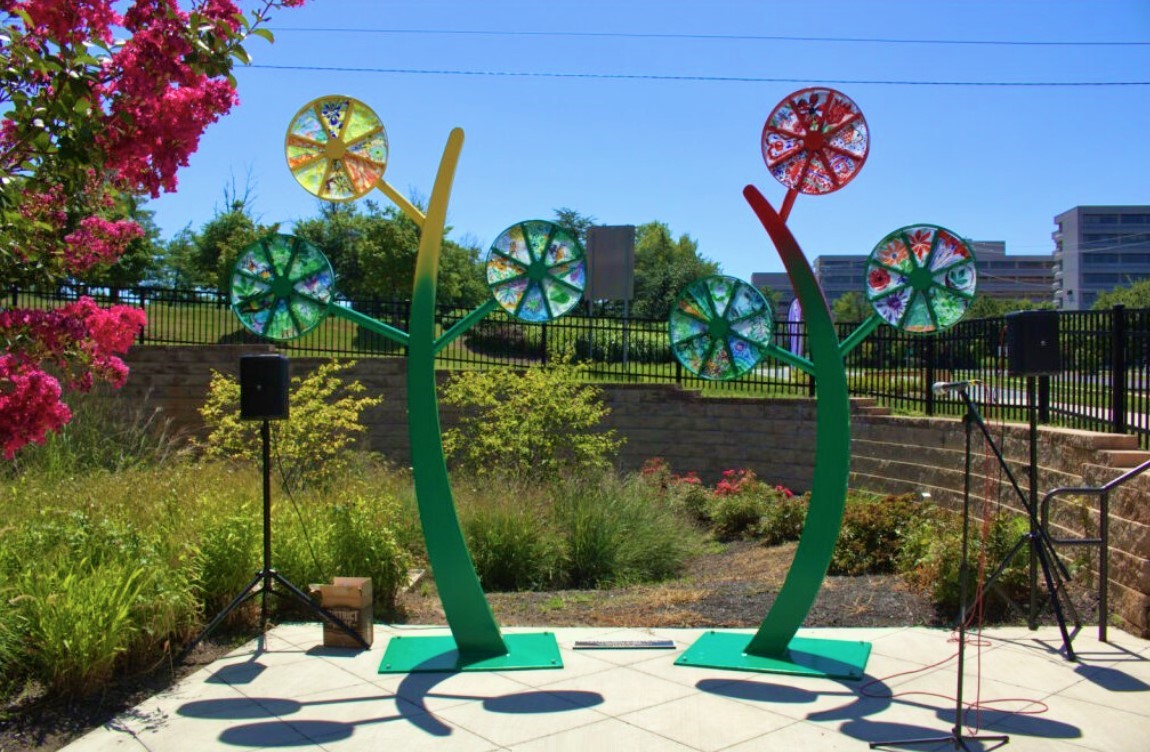
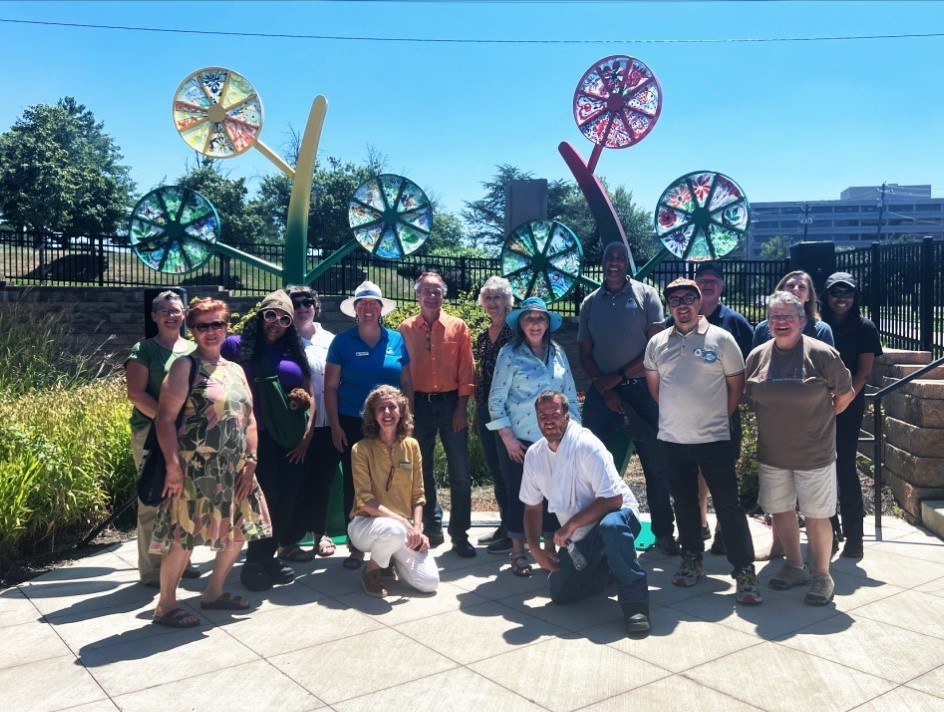
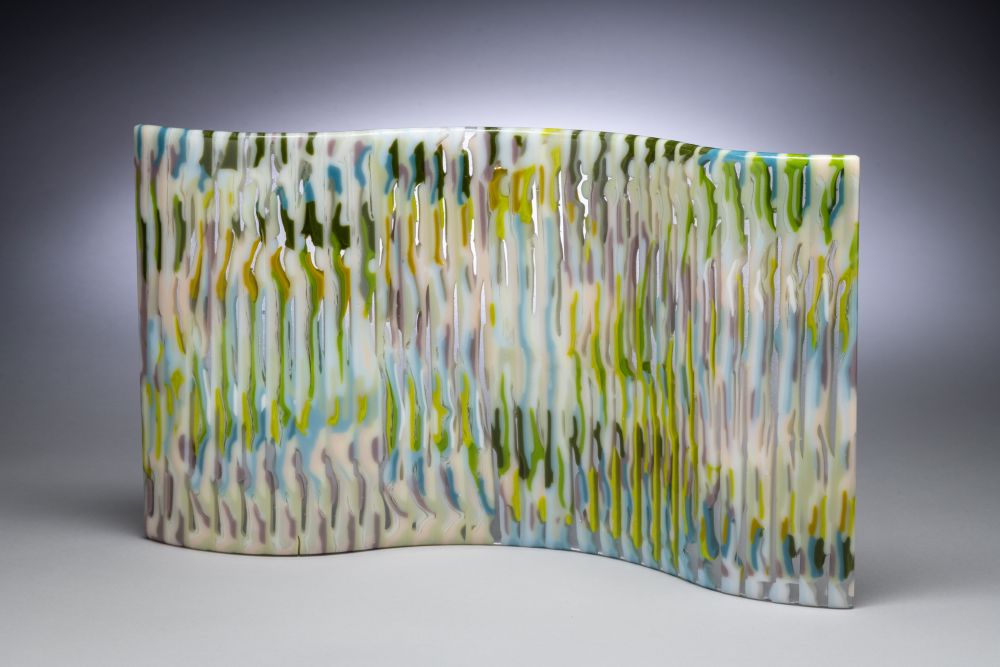
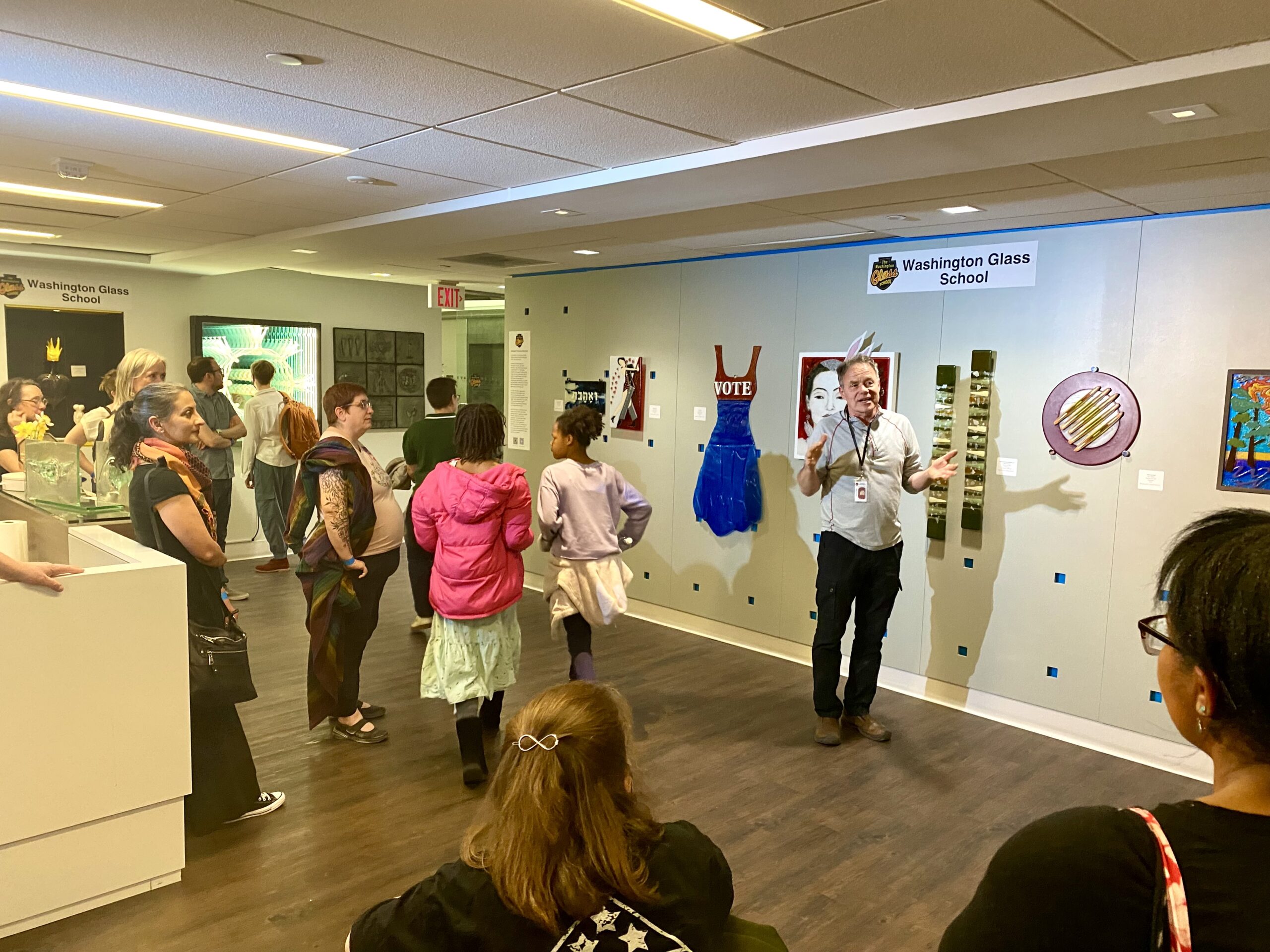
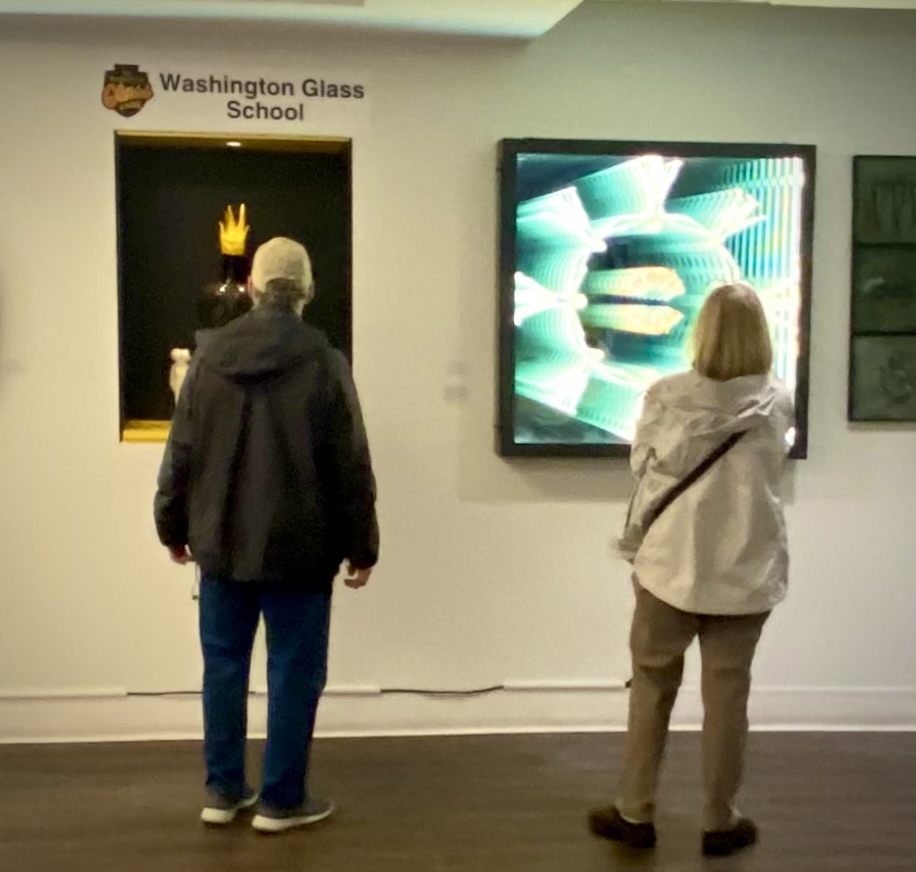
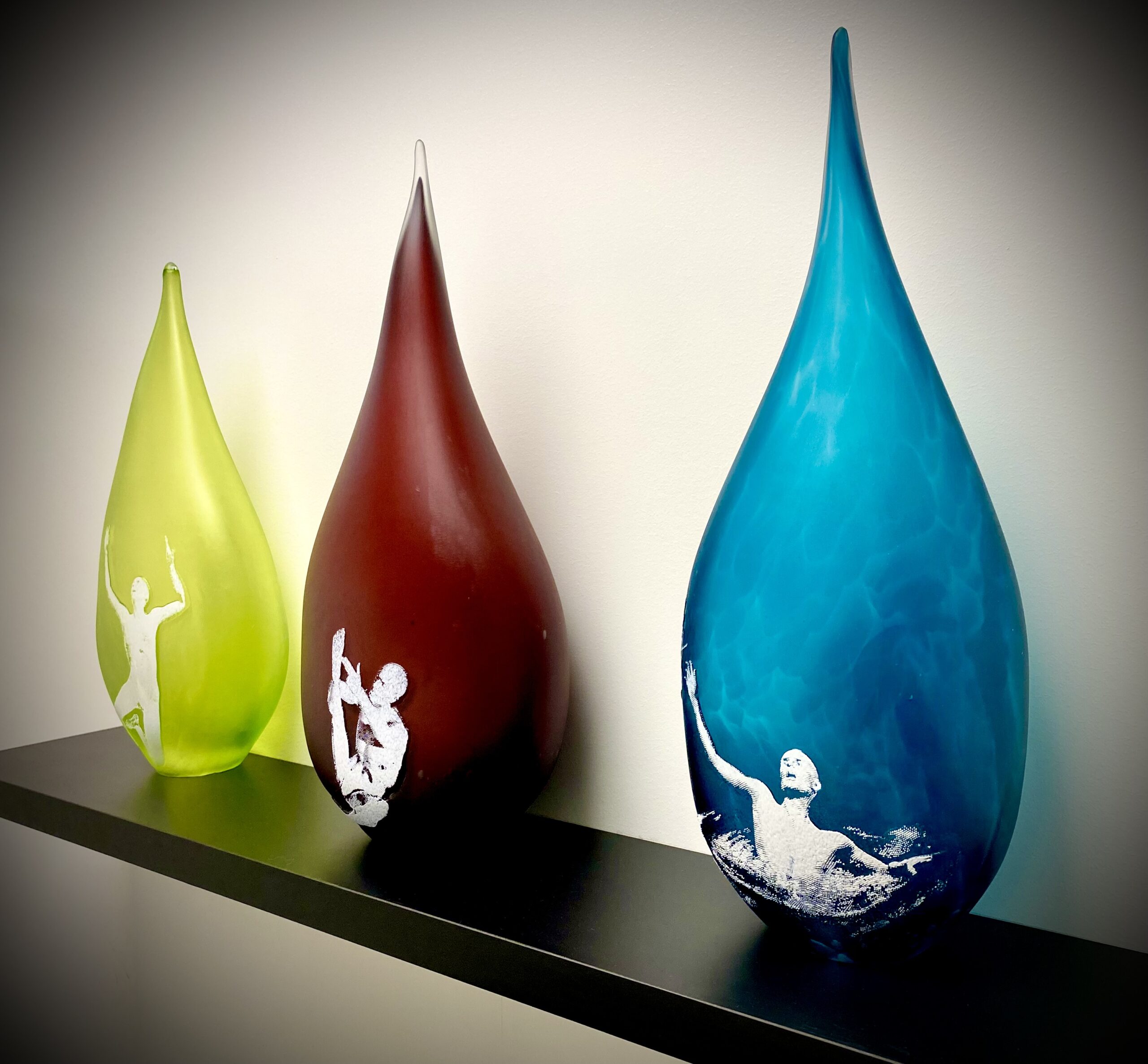
This past weekend, the City of Greenbelt, Maryland, celebrated the dedication of a stunning new public sculpture, The Beauty in a Garden Comes from More Than One Flower, created by Washington Glass School Co-Director and eco-artist Erwin Timmers.
Crafted from steel and recycled glass, the sculpture’s graceful petals carry a story far beyond their materials — they are the handiwork of the very community the artwork now welcomes. In a series of hands-on glass work sessions at the Washington Glass School in Mount Rainier, MD, residents of the new Motiva apartments and their Greenbelt neighbors joined Erwin in creating the vivid glass infill panels that make the piece glow with life and individuality.
“The concept was always about unity through diversity,” says Erwin. “Just like a garden thrives because it has many flowers, a community flourishes because of its different voices, talents, and hearts.”
The project, sponsored by Motiva, blossomed into more than just a public art commission — it became a joyful, collaborative journey. Over the course of multiple workshops, participants experimented with recycled glass, learned kiln-forming techniques, and left their personal creative mark on the sculpture.
The finished work now stands as both an artistic landmark and a symbol of connection — an invitation for all who pass by to remember that beauty is born from many hands working together.
💚 Washington Glass School is proud to have been part of this community-centered creation, bringing people into the making process and showing how recycled materials can tell vibrant new stories.
Congratulations to Erwin, to all the participating residents, and to Greenbelt Recreation Arts for championing public art that grows from — and for — the community.
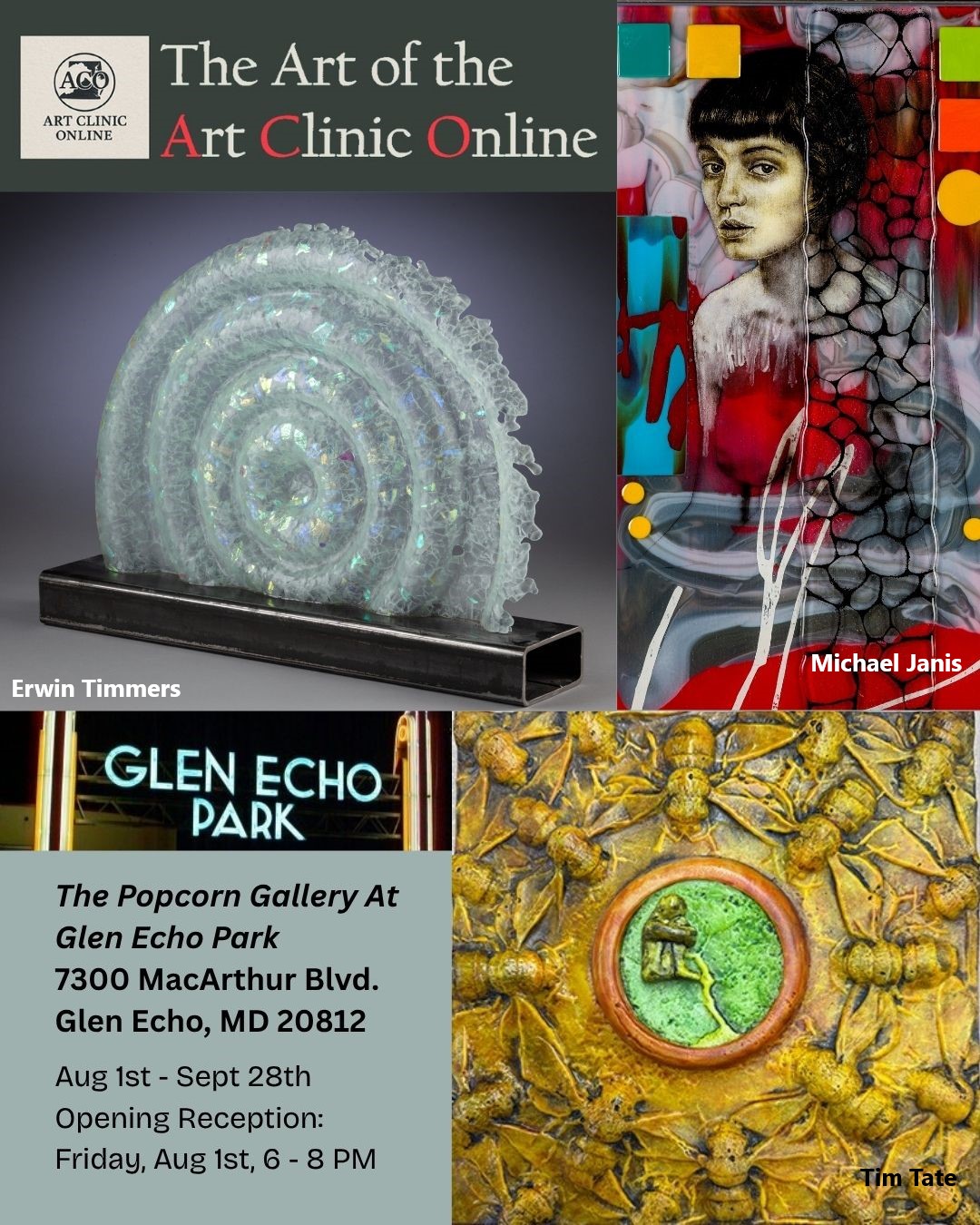
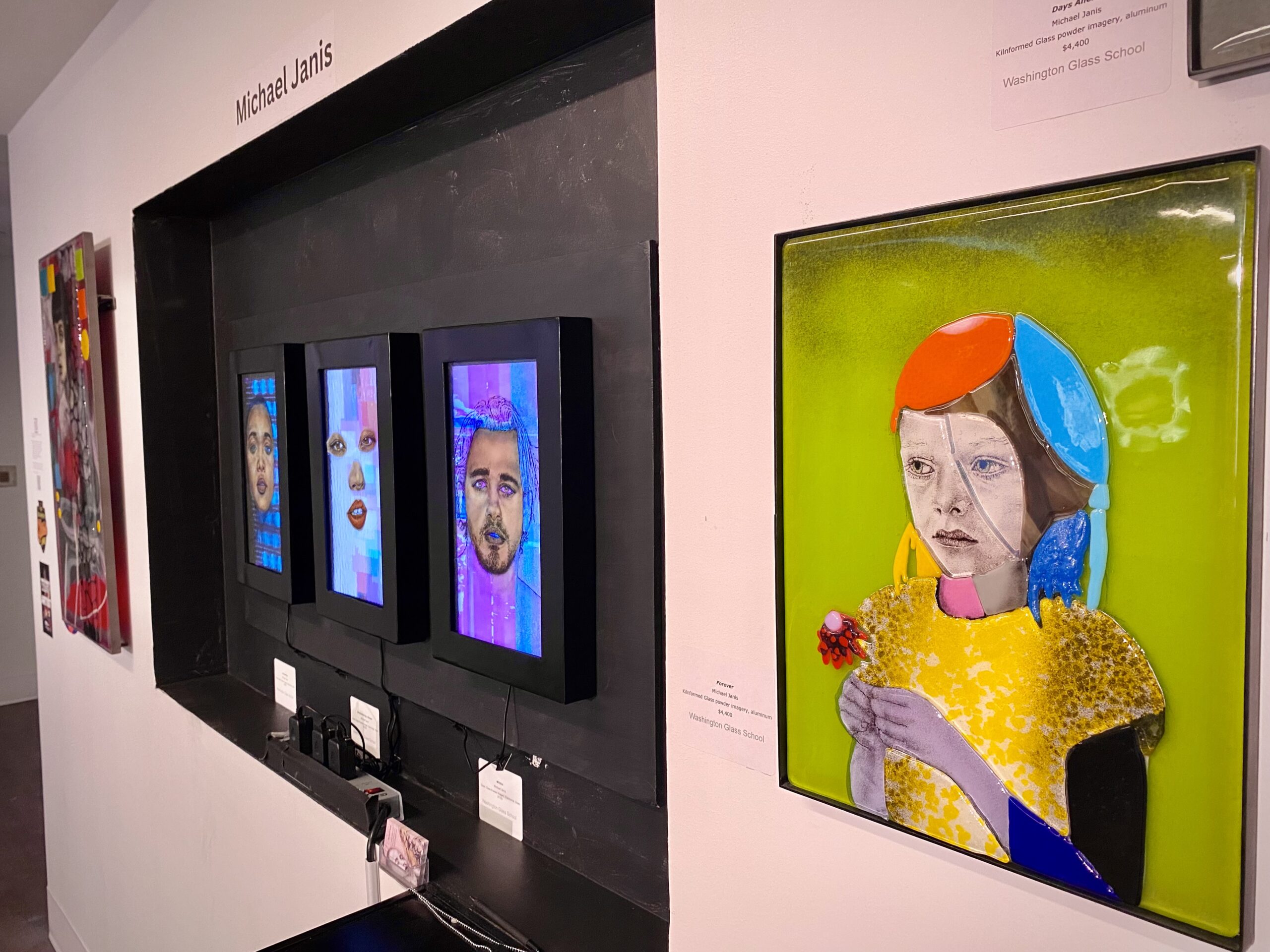
This Friday, August 1, The Art of the Art Clinic Online opens at Glen Echo Park’s Popcorn Gallery, showcasing an impressive lineup of over 30 artists from the DC-area Art Clinic Online (ACO) community—including Washington Glass School artists Erwin Timmers, Tim Tate, and Michael Janis.
Presented as part of Glen Echo’s First Friday Art Walk (6–8 PM), this group exhibition runs through September 28 and offers a compelling glimpse into the diversity of creative voices shaping the region.
📍 Popcorn Gallery Glen Echo Park 7300 MacArthur Blvd, Glen Echo, MD Free + open to the public
Founded in 2020, ACO has become a vibrant platform for community, conversation, and exchange among artists throughout the DMV. Every other Saturday, the group hosts online sessions where a featured artist presents their work and engages in lively dialogue with participants. The program’s inclusive spirit and broad range of voices are central to its mission—and now, those connections come off-screen and into the gallery space.
The Art of the Art Clinic Online is a reflection of the many practices and perspectives nurtured through ACO’s ongoing work, and we’re proud to see WGS artists included in this thoughtful and energetic survey.
Participating Artists Include: Blair Anderson, Maremi Andreozzi, Sondra Arkin, Julia Bloom, F. Lenox Campello, Eric Celarier, Aishwariya Chandrasekar, Schroeder Cherry, Jeffery Everett, Kate Fleming, Erin Fostel, Barbara Epstein Gruber, Ric Garcia, Sarah Jamison, Michael Janis, Robert Knudsen, Christine Lashley, Kyujin Lee, Laurel Lukaszewski, Akemi Maegawa, Dana Jeri Maier, Lindsay Mueller, Cory Oberndorfer, David Page, Erin Raedeke, Ephraim Rubenstein, Nicole M. Santiago, Tim Tate, Valerie Theberge, Erwin Timmers, Bennett Vadnais, Steve Wanna, Dawn Whitmore, and Andrew Wodzianski.
Make time to visit Glen Echo Park this summer—you’ll find a rich cross-section of the region’s creative talent and a strong sense of community threaded through every work on view.
The Washington Glass School is thrilled to celebrate the achievements of two of our talented resident artists, April Shelford and Kate Barfield, whose works have been selected for prestigious contemporary art exhibitions. Their unique glass artworks showcase the innovative spirit and technical mastery that define our studio’s creative community.
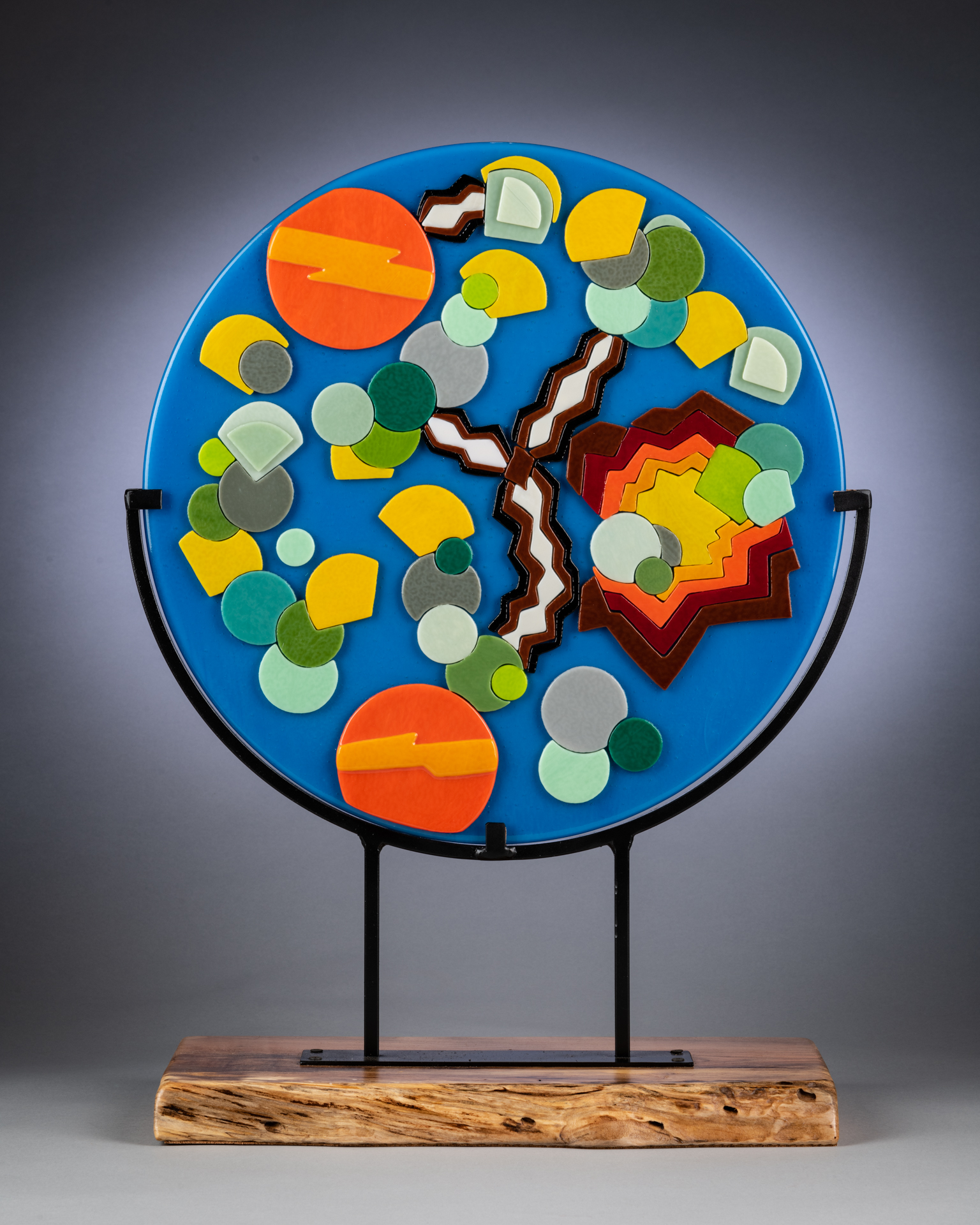
Artist: Kate Barfield; “Tribute to Ms. Mailou Jones”, Fused Glass, steel, wood; Photo Credit: Pete Duvall
Kate Barfield’s Vibrant Works at “The Power of Color” Exhibition
Kate Barfield’s captivating glass pieces, Tribute to Ms. Lois Mailou Jones and Rejoice Wind Up Bird, have been selected for the upcoming The Power of Color exhibition, sponsored by MD Fine Arts at the Circle Gallery in Annapolis, Maryland. This show highlights the dynamic use of color in contemporary art, and Kate’s work perfectly embodies this theme. Her piece Tribute to Ms. Lois Mailou Jones pays homage to the renowned Black DC painter, capturing the angular shapes, curves, and vibrant “POW!” of color that defined Jones’ work. Rejoice Wind Up Bird further showcases Kate’s ability to infuse glass with narrative depth and vivid expression. We invite you to visit the Circle Gallery to experience these stunning works in person and see how Kate’s artistry transforms glass into a powerful storytelling medium. MFA’S Circle Gallery from July 30th – August 23rd, 2025
Artist: April Shelford; “To Monet”, Fused Glass; Photo Credit: Pete Duvall
April Shelford’s To Monet in “A Sense of Place” Online Exhibition
April Shelford’s evocative piece To Monet has been selected for the A Sense of Place online exhibition, launched on July 7, 2025, by the Contemporary Glass Society (CGS), the UK’s foremost organization supporting glass artists. This global celebration of glass art features 77 international artists, each exploring how glass captures personal and cultural connections to place. April’s To Monet reflects her signature focus on color and pattern, inspired by her meticulous attention to detail and questing curiosity. Her fused glass work, reminiscent of the historian’s craft, assembles diverse elements into a cohesive and meaningful whole, evoking a profound sense of place. This online exhibition offers a unique opportunity to explore April’s work alongside other visionary glass artists from around the world. Visit the CGS website to immerse yourself in this remarkable showcase.
Celebrating Our Artists’ Vision and Craft
Both Kate and April exemplify the Washington Glass School’s commitment to pushing the boundaries of glass as a medium for contemporary art. Their selections for these prestigious exhibitions highlight their individual talents and the vibrant creative energy fostered at our studio. We are incredibly proud of their contributions to the global glass art community and invite you to join us in celebrating their achievements.
Stay tuned for more updates on our artists’ exhibitions and events, and visit the Washington Glass School to discover the transformative power of glass art!
Washington Glass School resident artist Patricia de Poel Wilberg will be featured in the upcoming “New Connections in Glass” exhibit at the Ice House Gallery in Berkeley Springs, WV. Curated by Maureen Storey, the show runs from May 30 to July 27, 2025, with an Opening Reception on Saturday, May 31, from 6:30 – 8:30 PM.
The exhibition brings together eight exceptional glass artists exploring diverse techniques and perspectives within the medium. Each artist offers a unique lens into the many ways glass can be transformed, manipulated, and used to tell visual stories.
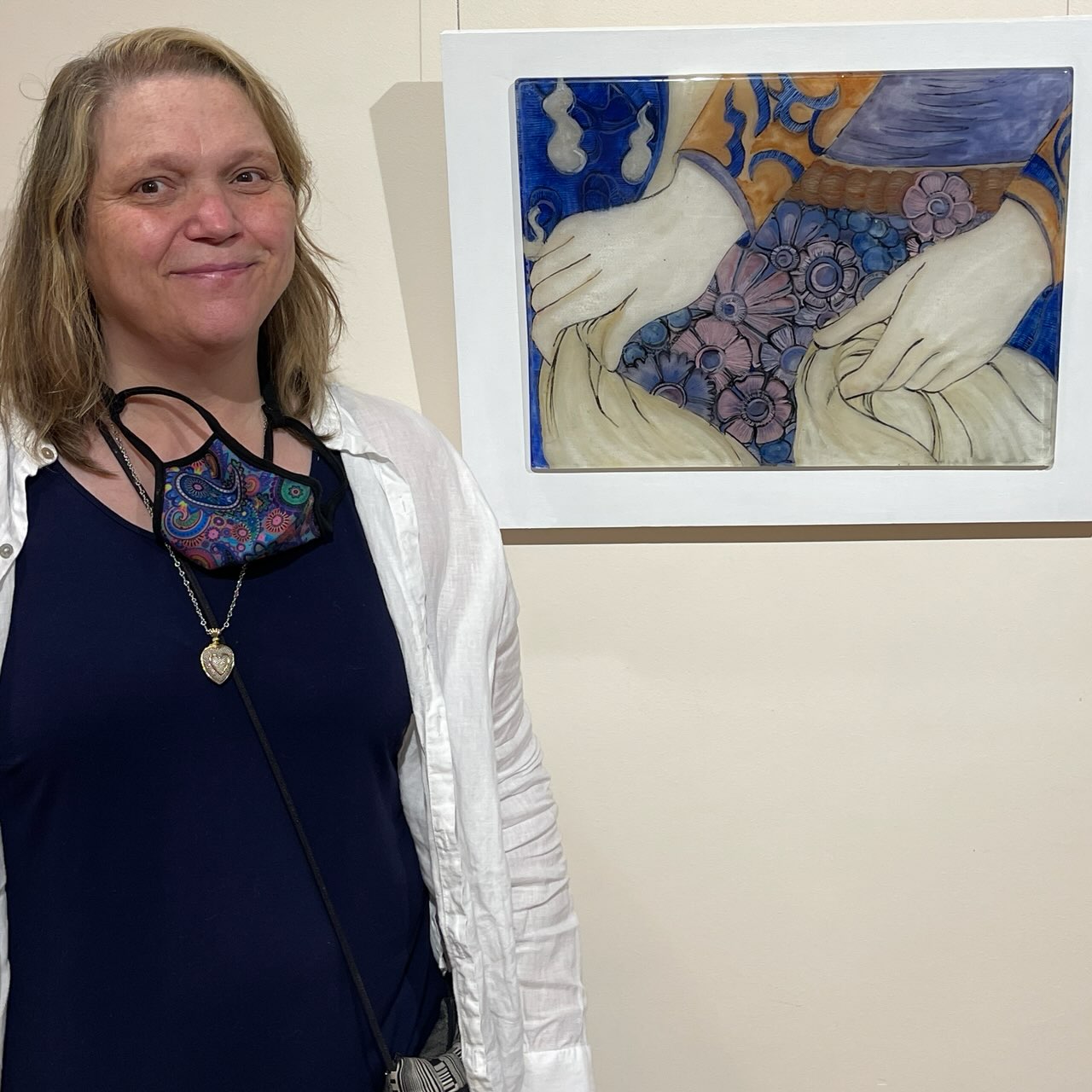
Patricia de Poel Wilberg’s work continues to captivate with her painterly approach to glass. For this exhibit, Patricia debuts a vibrant new series of figurative panels celebrating noted women artists throughout history. These tributes aren’t just portraits—they’re rich, layered interpretations that reference each subject’s distinctive art and style, translated into glass.
Patricia de Poel Wilberg working on her new glass artwork series
Using vitreous enamels and kiln-formed glass, Patricia meticulously builds her panels through multiple firings, fusing and reforming components to create dynamic narratives. Her newest works honor the legacies of women whose creative voices have shaped the art world—brought to life in color, texture, and light.
Evolution of Patricia’s glass artwork tribute to Yayoi Kusama. (The Japanese artist known for their signature use of polka dots and large-scale installations.)
“I wanted to show how the spirit of these artists can be reinterpreted through the language of glass,” Patricia explains. “Each panel is a conversation between their work and mine.”
Featured artists in the show include: Elizabeth Braun Rachel Brooks Mark Hill Sharon Moffitt Patricia de Poel Wilberg Laurie Madsen Snarr Maureen Storey Nancy Weisser
We encourage everyone to make the trip to the scenic Ice House Gallery to see this remarkable collection and to support Patricia and her fellow artists. It’s sure to be a stunning and inspiring celebration of innovation in glass.
New Connections in Glass May 30 – July 27, 2025 Opening Reception: Saturday, May 31, 6:30 – 8:30 PM Ice House Gallery 138 Independence Street, Berkeley Springs, WV 25411 www.icehousecoop.com
National Building Museum, 401 F Street NW, Washington, DC 20001
Step into the world of architecture, design, and history at the National Building Museum in Washington, D.C. Located at 401 F Street NW, just four blocks from the National Mall.
WGS leads workshop at the National Building Museum.
Washington Glass School Event! : A Maker’s Workshop: The Art of Mosaics Join Graciela Granek from The Washington Glass School for a hands-on mosaic workshop inspired by the Visible Vault exhibition. Two sessions are available on May 17: 10:15 a.m.–12:15 p.m. and 2:00 p.m.–4:00 p.m. (NOTE: Both sessions are now SOLD OUT!!) Don’t miss the chance to explore the stories of the world we design and build. Visit the National Building Museum and be inspired!
Washington Glass School Co Founder Erwin Timmers outlines the Studio Glass Movement timeline to audience at Artomatic 2024.
In the 1960s, The American Studio Glass movement transformed glass from craft into fine art.
Artomatic helped create the movement, as after the 2000 Artomatic, the Smithsonian Museum acquired artist Tim Tate’s glass sculpture that was on display. Artist Erwin Timmers’ artwork was also on exhibit at that Artomatic, and after that show, the two began to collaborate, later teaming up to start the Washington Glass School & Studio with the funds from the sale of Tate’s glass artwork to the Renwick.
Washington Glass School Co-Founder Tim Tate’s work at Artomatic 2024.
In 2008, Artomatic organized an exhibit at the Washington Glass School, showcasing the unique approaches to glass sculpture in three “glass” cities: Washington, DC; Toledo, Ohio; and Sunderland, England, fostering international partnerships and collaborative ventures.
Glass works by VA-based artist Griffon Dillon on exhibit at Artomatic 2024.
As the 21st century unfolded, artists across various media have shown growing interest in glass as a creative medium, despite its technical challenges. The Washington Glass Scene has emerged as a hub of innovation, elevating glass to a significant position in contemporary art. The Washington Glass School encourages artists to push boundaries and redefine the possibilities of glass as a fine art medium.
There is a great example of works by DC glass creatives on display at Artomatic 2024, open now thru April 28th. Although the glass works are on many of the 8 floors of art, the 5th floor is the central spot to get ones glass fix. Some photos of Washington Glass School’s reception are featured in this post.
Glass artwork by artist Michael Janis seen at Artomatic 2024 on M Street.
Curator Howard Cohen reviewing glass art on exhibit at Artomatic 2024.
Baltimore based art curator Howard Cohen came this past weekend to Artomatic to handpick glass artists from the DC area for a contemporary glass showcase exhibit at Montpelier Art Center this June. Howard was able to talk with many of the artists and get insight to their narratives and process. Looking forward to the upcoming show!
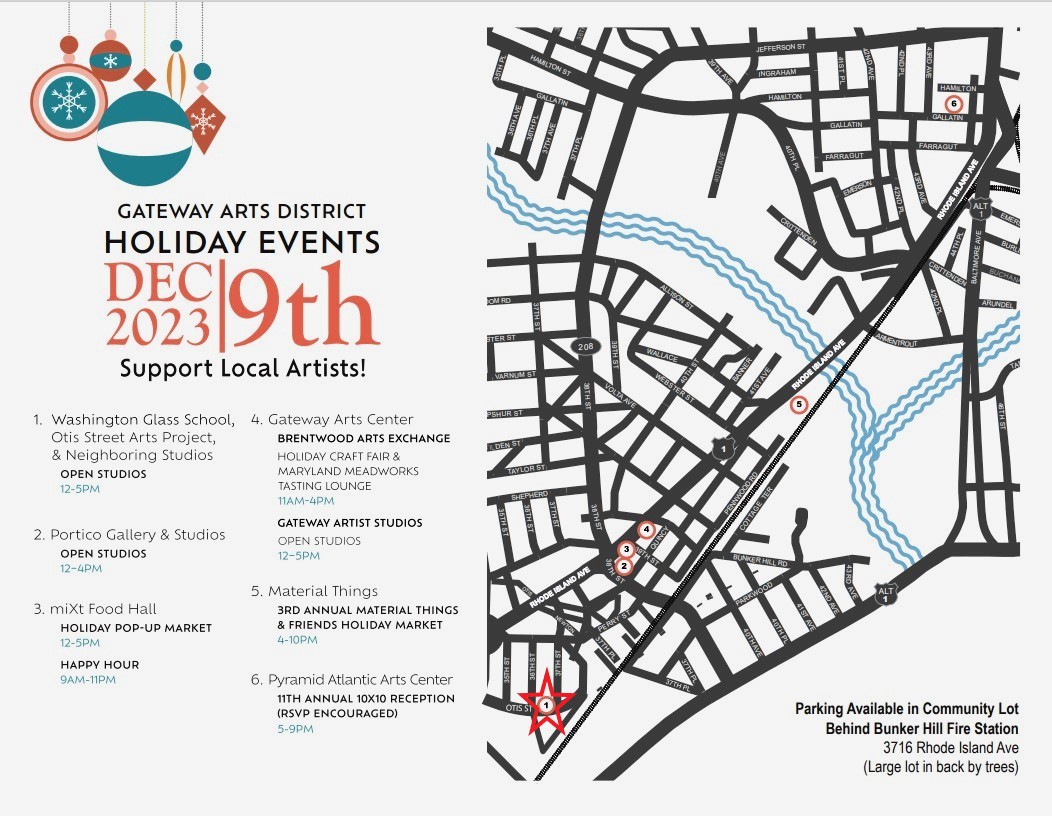
December 9, 2023 from Noon til 5PM – Holiday Open Studios! See some of the best art and design by the area’s most talented makers! A special exhibit of sculpture made by Military Veterans in Washington Glass School’s “Hot Shop Heroes” workshop held in collaboration with the Museum of Glass will be fetured at the WGS Contemporary Gallery, 3700 Otis Street, Mt Rainier, MD 20712. Artist Talk at 1PM.
Tip: Start your tour in the numerical order listed!
WASHINGTON, D.C. and TACOMA, WASHINGTON — The Washington Glass School in Mount Rainier, MD is proud to announce a groundbreaking collaboration with the Museum of Glass in Tacoma, Washington, aimed at enhancing the lives of military personnel and veterans through the transformative power of Hot Shop Heroes™. As one of the first collaborations of its kind for the Museum of Glass, this partnership underscores their dedication to expanding the horizons of glass artistry. By combining the Washington Glass School’s expertise in glass art instruction with the Museum of Glass’s world-class facilities and resources, this alliance of the two Washingtons (State and District of Columbia) promises to create a nurturing and enriching environment where veterans can discover the healing potential of working with glass.
Hot Shop Heroes is a pioneering program that has been instrumental in aiding military personnel and veterans in their journey to heal from traumatic experiences and injuries sustained during combat. The program creates a supportive environment where participants work collaboratively, forging bonds with one another while exploring the captivating art of molten glass. The blend of social interaction, shared goals, and creative expression within the Hot Shop Heroes program offers a unique and therapeutic experience that has been proven to promote healing and personal growth.
According to the American Art Therapy Association, the debilitating effects of post-traumatic stress can affect up to 18-percent of soldiers deployed to Iraq and Afghanistan. For many, the use of medication, cognitive behavioral therapy (CBT), or eye movement desensitization and reprocessing (EMDR) can be helpful in treating this condition, but the addition of art therapy has shown to be invaluable to an individual’s recovery.
This remarkable initiative started as a Museum of Glass created opportunity for military members and their families to engage in hands-on art activities, glassblowing demonstrations, and gallery exhibitions, has evolved into a program specially designed to assist active-duty and retired service men and women in their transition to civilian life. The program has demonstrated that the concentration and camaraderie required for glassblowing can be profoundly therapeutic, particularly for individuals with traumas and injuries stemming from their military service.
Since its inception in the fall of 2013, the Hot Shop Heroes program has been dedicated to teaching kiln formed glass safety procedures, fundamental glassmaking techniques, welding experience, and team building skills.The program’s objectives are to provide participants with improved dexterity, fine motor coordination, and core strength, all while fostering self-esteem, nurturing creativity, and stimulating imagination through artistic participation. Today, Hot Shop Heroes remains a cornerstone educational program at the Museum of Glass, transforming lives through art.
The Hot Shop Heroes program offers glassmaking and metal shop courses to participating soldiers and veterans, catering to introductory and intermediate skill levels. With classes tailored to different levels of glassmaking experience, Hot Shop Heroes empowers participants to refine their abilities, extending the reach of their skill sets beyond the walls of the Glass Studio and into new job opportunities.
To sustain and expand this life-changing program, Hot Shop Heroes relies on external funding to provide classes at no cost to participating students. As of 2023, over 750 soldiers and veterans have benefited from the Hot Shop Heroes program, and this collaboration between the Washington Glass School and the Museum of Glass aims to extend the reach of this transformative initiative to even more individuals in need.
For more information about the Hot Shop Heroes program and this exciting collaboration between the Washington Glass School and the Museum of Glass, please visit http://washingtonglassschool.com/school
The Washington Glass School, located in Mt Rainier, MD is a renowned educational program in the Nation’s Capital area, operating as the sculptural glass education and resource center for the mid-Atlantic region, serving students, artists and the general public. Founded in 2001 by passionate glass artists, the school offers a wide range of classes, workshops, and educational programs aimed at fostering creativity and innovation in the world of glass sculpture.
About Museum of Glass:
The Museum of Glass, situated in Tacoma, Washington, is a premier institution dedicated to the appreciation and exploration of glass art. With a world-class collection and a mission to engage and inspire a broad and diverse audience, the Museum of Glass is a hub for creativity, education, and artistic expression.
The National Capital Art Glass Guild (NCAGG) was founded in 1978 as a community of artisans interested in art glass. Every year Guild members conduct classes in many glass techniques and present programs to interested schools, organizations, and community groups.
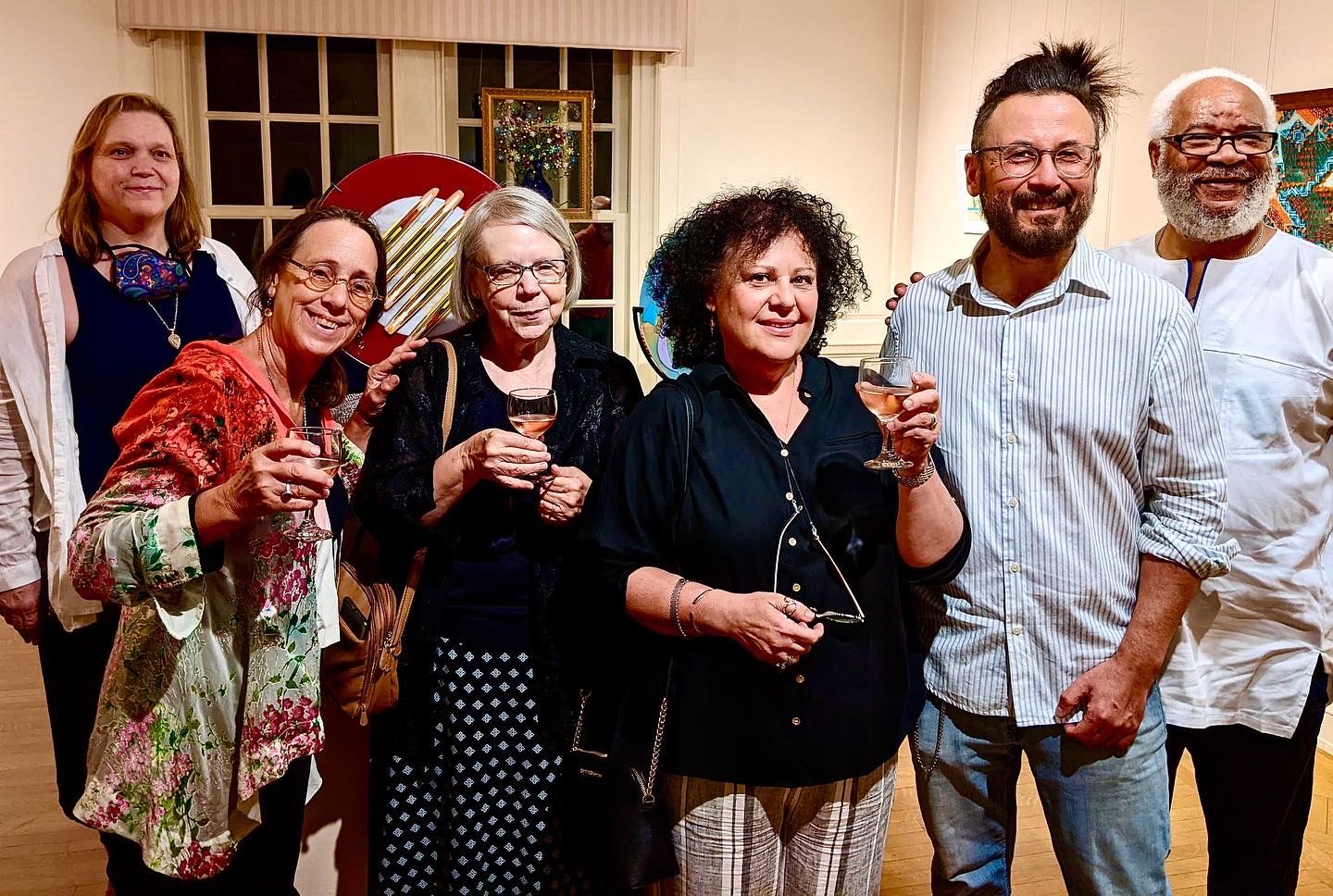
WGS Artists at NCAGG Exhibit L-R Patricia de Poel Wiberg, Kate Barfield, April Shelford, Graciela Granek, Michael Janis, John Henderson.
The juried NCAGG member show at the Strathmore Mansion features outstanding works by area glassmakers in multiple styles – and many works by WGS artists!
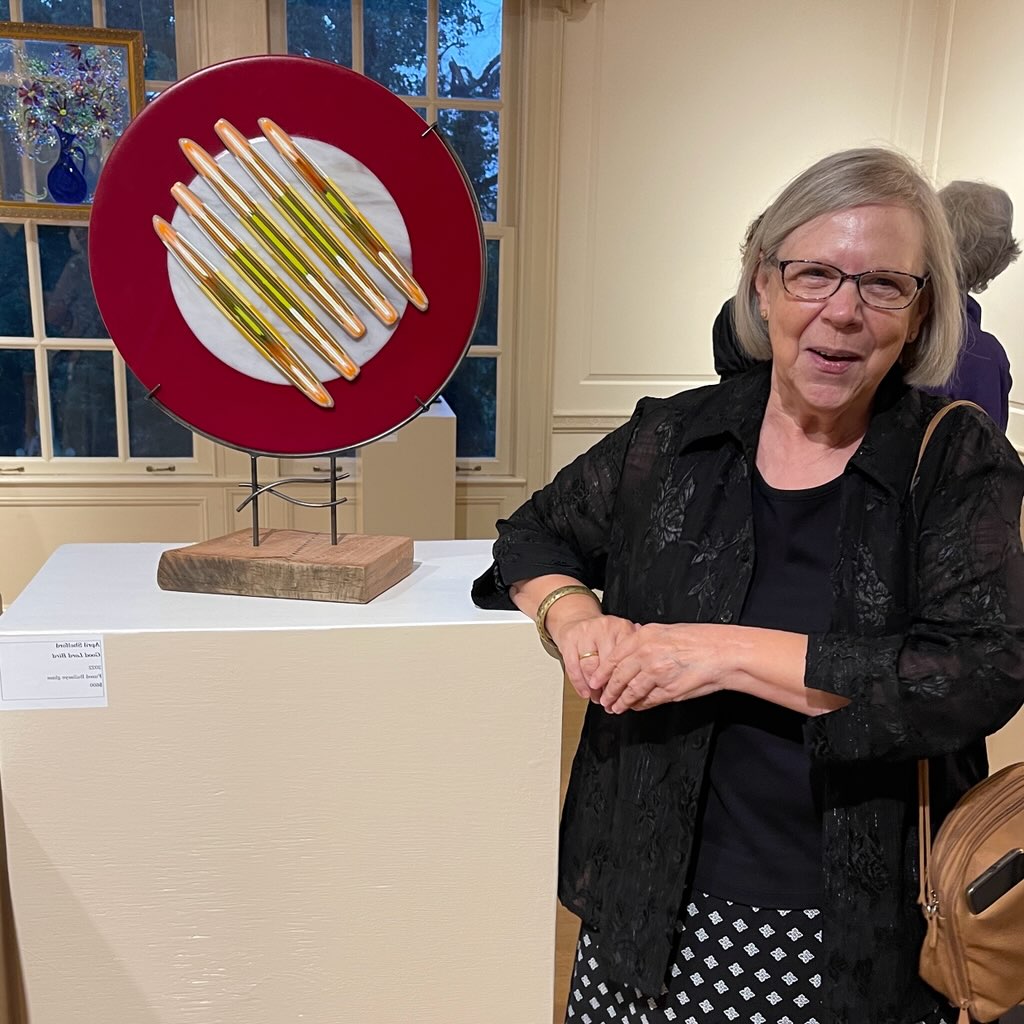
Patricia de Poel WilbergApril ShelfordKate Barfield
The show runs through October 28, 2023
April Shelford in awe of Erwin Timmers’ cast sculptures.