The Experiment That Lasted 25 Years

Tim Tate co-founded the Washington Glass School to break every rule he’d inherited. A quarter century later, it’s still running — and so is he.

Washington Glass School in Mt Rainier, MD

The first thing you should know about Tim Tate is that he didn’t expect any of this to last.

When he and his co-founders — Michael Janis and Erwin Timmers — opened the Washington Glass School in the early 2000s, Tate gave the whole project maybe three years. He was running an experiment, not building an institution. The question driving it was deceptively simple: what would a glass school look like if it wasn’t tethered to the conventions of classic studio glass? Could it survive? Could it actually make something?

Twenty-five years and thousands of students later, the answer is self-evident.

Tim Tate circa 1999. (so young!)

Tate began his art career as a young HIV-positive queer man in the full, brutal heat of the AIDS crisis. He was the founder and director of the Triangle Artist Group in Washington, DC, and the director of the city’s first Art Against AIDS charity event — a benefit that raised funds for the newly established DC LGBTQ+ Community Center and the HIV-positive children’s ward at Washington Children’s Hospital. He was shaped by that community, trained in its values, fluent in its urgency. Civil rights and human justice weren’t themes he would later introduce into his work. They were the water he swam in from the beginning.

Tim Tate, “Two Paths Taken”, photo by Pete Duvall

That formation never left him. It structured how he thought about art, about purpose, and eventually about what a school could be.

_________________________________

The Washington Glass School was founded on a principle that sounds obvious but is, in practice, radical: everyone’s success is not achieved at the expense of anyone else’s. Tate had spent time in studios corroded by envy, watching artists diminish each other. He wanted something different. A rising tide, he believed, floated all boats — and so the school was built with that ethos embedded in its architecture.

Images from The Washington Post newspaper article about the Glass School, 2002. Photos by Mark Sypher.

The governance structure reflects the same logic. Tate, Janis, and Timmers operate as equal co-directors, each carrying a different set of responsibilities. When disagreement arises, they vote — and two out of three must agree. “We all had the same goal,” Tate says simply. “To keep the school alive and thriving.”

Washington Glass School directors in 2022, L-R the oh-so-handsome and super sexy compelling Michael Janis, Tim Tate and Erwin Timmers.
L-R Washington Glass School trinity: Michael Janis, Tim Tate, Erwin Timmers

That structure has held for 25 years. Not because there have been no disagreements, but because the underlying commitment was always shared.

_________________________________

The artistic agenda was never modest. Tate wanted to use electronics. Video. Wood, plastic, ceramics, paint. He wanted to find out what glass could become when it wasn’t required to stay within the boundaries drawn by 20th-century studio tradition.

Early on, he and William Warmus — the former curator of glass at the Corning Museum — founded a Facebook discussion group they called “Glass Secessionism,” a deliberate echo of Alfred Stieglitz’s Photo Secessionism movement. The name alone provoked. People were annoyed. Definitions were demanded. The two men eventually produced a 17-page warrant articulating what they meant.

Tim Tate and William Warmus reviewing artwork at Chicago art fair, 2014

Monica Moses, the then-editor of American Craft Magazine told them the controversy would be short-lived — that the ideas would simply become the norm. “And so it did,” Tate says now, with something closer to relief than triumph.

American Craft Magazine, April May 2014

Technology in his work, he explains, was never an end in itself. It was a tool. A metaphor. “A video was worth a thousand words” — an expansion of a single image, a way of deepening what glass alone could carry.

_________________________________

The work deepened alongside the politics. What had seemed to wane in the calmer early 2000s — the appetite for socially engaged art — came back hard as the political climate grew more charged. Today, one of Tate’s favorite classes to teach is called “Using Glass for Social Justice.” The curriculum, in a sense, is his biography.

Tim Tate, 12 Souls, 12 Resurrections, photo by Pete Duvall

His sculptures move through reliquary traditions and Victorian curiosity cabinets, through early cinema and the formal logic of Georges Méliès. They are blown and cast, embedded with video screens, built around found objects, animated by the tension between fragility and permanence that glass uniquely embodies. They hold names, poems, histories.

His piece Nine Future Supreme Court Justices imagines an LGBTQ+ legal future — nine figures, each identified, each carrying biographical weight. In Service, In Secret animates archival photographs of queer men and women in uniform, from the Civil War through World War II. When the Armor Becomes Wings places two glass figures in the act of shedding the armor of survival — one holding a crocus, one a red bird — beneath a blown glass dome crowned with a winged heart.

These are not decorative objects. They are arguments in glass.

_________________________________

The recognition has arrived steadily, and Tate wears it carefully. He has shown at the Venice Biennale exhibitions three times. He exhibited at the State Hermitage Museum in St. Petersburg before the Russia–Ukraine war made that world inaccessible. His work is held in the permanent collection of the Smithsonian American Art Museum and the Renwick Gallery. He designed the New Orleans AIDS Memorial.

New Orleans AIDS Memorial

He carries all of it back to DC deliberately. “I want DC and the glass school to be realized as major players in the art world,” he says. “It’s such a great city with astounding artists. I add what I can.”

_________________________________

Now comes the largest undertaking of his career.

Imagining Utopia: What Would America Look Like If It Were a Queer Accepting Country? is a major solo traveling exhibition that opens in September 2027 at the Katzen Arts Center at American University in Washington, then travels to the Lowe Art Museum in Miami, the Asheville Art Museum, and finally the Palm Springs Art Museum, where it runs through all of 2029. It is the kind of show that, as Tate acknowledges quietly, he couldn’t have imagined mounting a decade ago. He credits a seven-month collaborative relationship with the MacArthur Fellow Joyce Scott — an artist who works at the intersection of beadwork, performance, and social critique — as a turning point. Scott showed him the scale his thinking could reach.

Tim Tate, Charter of 36 Points of the LGBTQIA+ Bill of Rights, kiln cast glass, mixed media

The exhibition poses its question directly, without softening. It does not ask audiences to abstract the politics into aesthetics. It asks them to imagine — concretely — what a more accepting America would look like, feel like, be.

The piece The Common Thread, a six-foot collaborative cast glass tile wall made with Michael Janis, anchors the exhibition’s material ambition. The Resurrections series — which includes 12 Souls, 12 Resurrections — enacts a different kind of memorial, one that refuses finality.

Six-foot cast glass tile wall titled The Common Thread, collaborative artwork by Tim Tate and Michael Janis, presented as part of the Imagining Utopia exhibition. The work uses layered fused glass panels to explore collective memory and social justice themes alongside the Resurrections series (12 Souls, 12 Resurrections), which reframe memorialization through contemporary glass sculpture.
Tim Tate & Michael Janis, The Common Thread, 2026, 3′-0″ H x 6′-0″W, kiln cast glass, mixed media. Photo by Pete Duvall.

_________________________________

Ask Tim Tate what he’s most proud of that has nothing to do with his own artwork, and the answer comes without hesitation: Over 6,000 students in 25 years. A school that chose DC and that DC chose back.

Ask him what belief he’s completely reversed in 25 years: “That there is but one way to do anything. Everything has numerous paths.”

Ask him what he would do if he couldn’t make glass for five years: “I would become the world’s best pie maker.”

And ask him what would happen if that 25-year-old version of himself walked into the studio today — the young HIV-positive artist navigating the AIDS crisis, running benefits, learning to make things out of fire — and he pauses.

“He would probably start crying tears of joy.”

Stay tuned for exhibit updates!

_________________________________

The Washington Glass School celebrates its 25th anniversary this year, with a group exhibit at Brentwood Arts Exchange in Brentwood, MD. Tim Tate’s touring exhibition Imagining Utopia opens at the Katzen Arts Center at American University in September 2027.
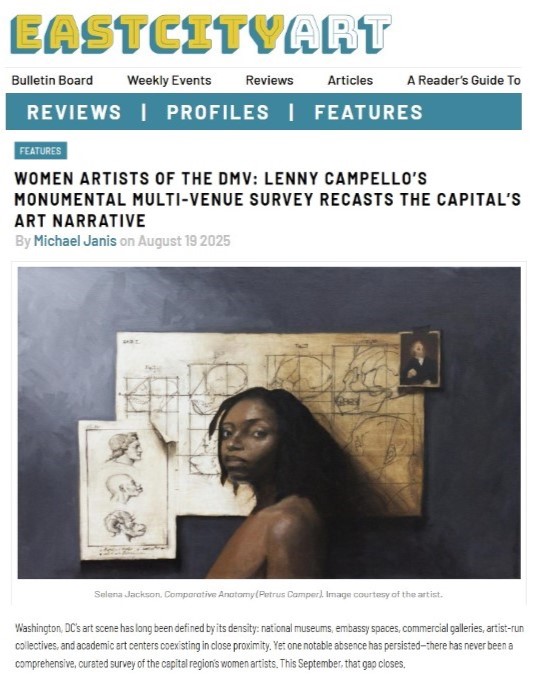
WOMEN ARTISTS OF THE DMV – A Historic 16-Venue, 300+ Artist Exhibition

Washington Glass School is proud to share that several of our artists are featured in the groundbreaking exhibition “Women Artists of the DMV”!

This fall, curator and artist F. Lennox “Lenny” Campello launches a historic 16-venue, 300+ artist survey across DC, Maryland, and Virginia—celebrating the creativity and impact of women artists in our region.

WGS artists, including April Shelford, Trish Kent, Diane Cabe, Erin Antognoli, Patricia de Poel Wilberg, and Kate Barfield are amongst the talented voices included in this unprecedented show—equal parts cultural intervention and historical record.

📖 Read more via East City Art: https://www.eastcityart.com/features/dmvwomen2025/
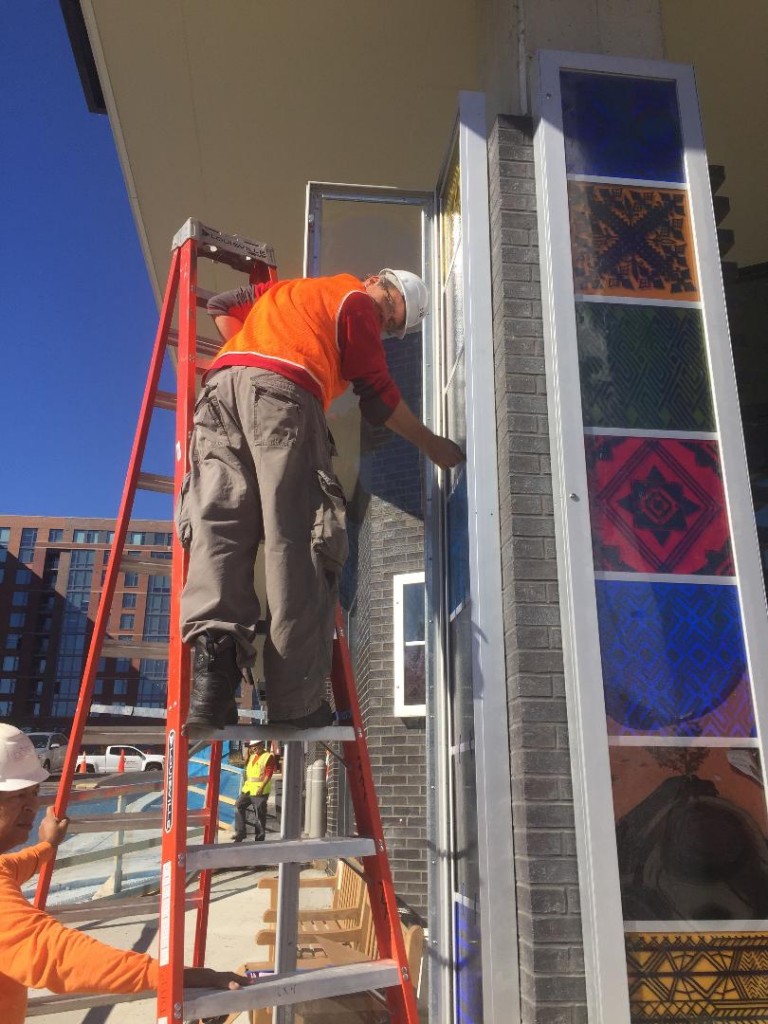
The Process: Public Art 900 Thayer in Silver Spring, MD – “Social Fabric”

Public art can strengthen social bonds, especially for culturally diverse neighborhoods.

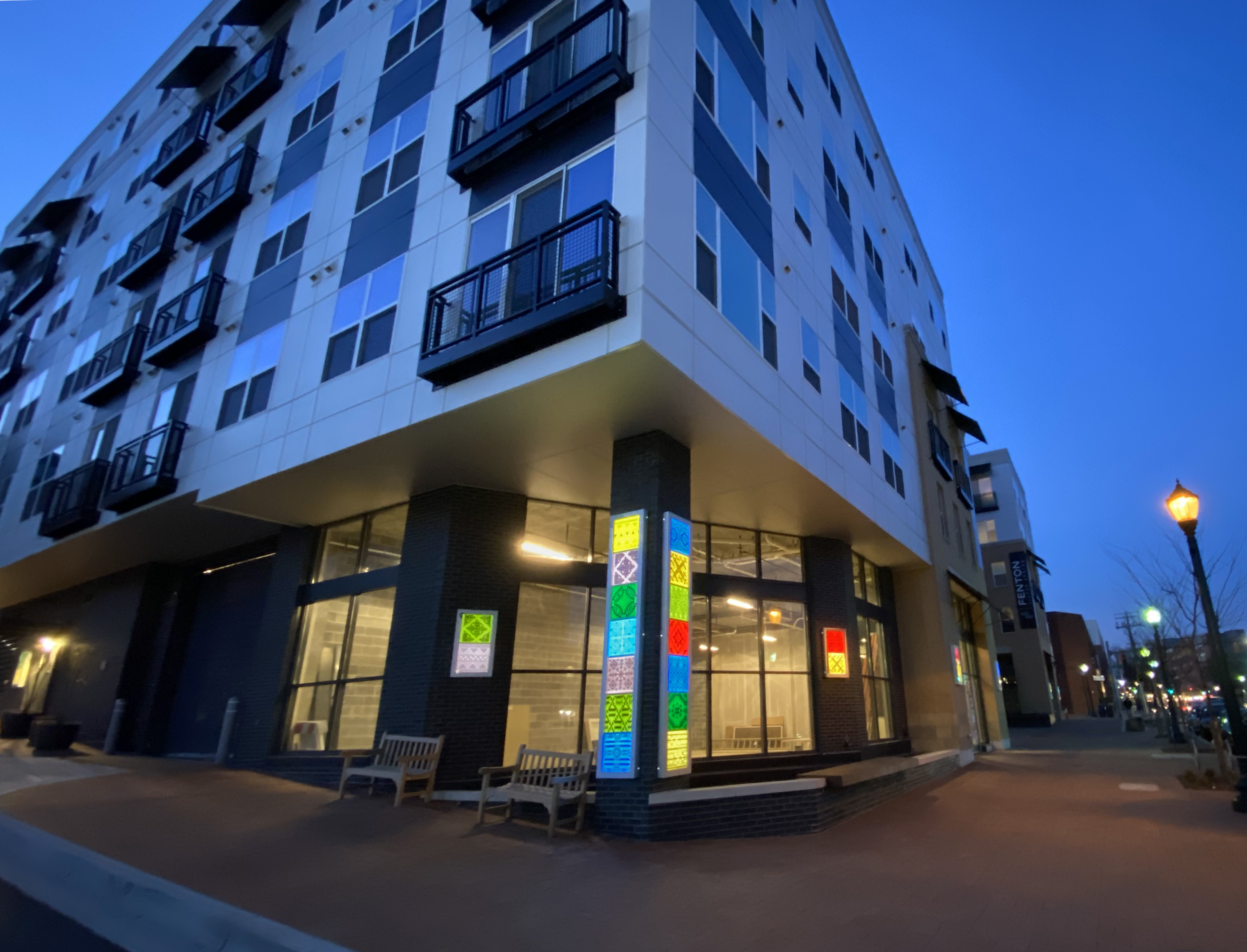
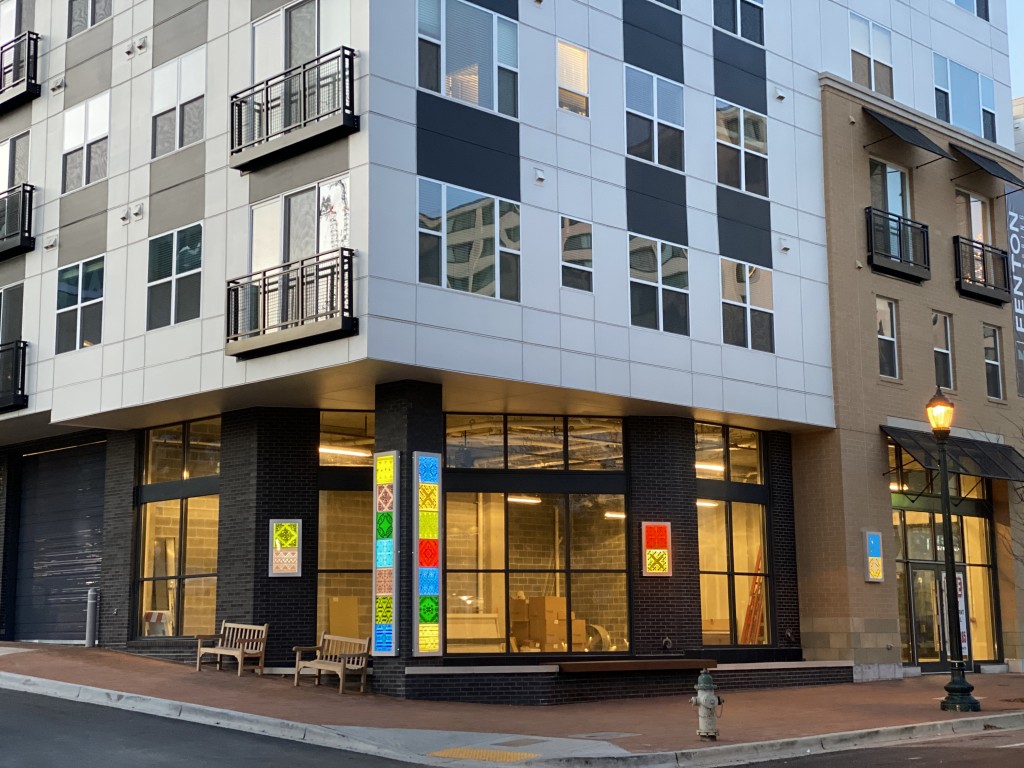
Corner installation of "Social Fabric" public art at Fenton Apartments in Silver Spring, MD.

Corner installation of “Social Fabric” public art at Fenton Apartments in Silver Spring, MD.

Washington Glass Studio recently completed a public art project in Silver Spring, MD, for a new mixed use development at 900 Thayer Ave. 

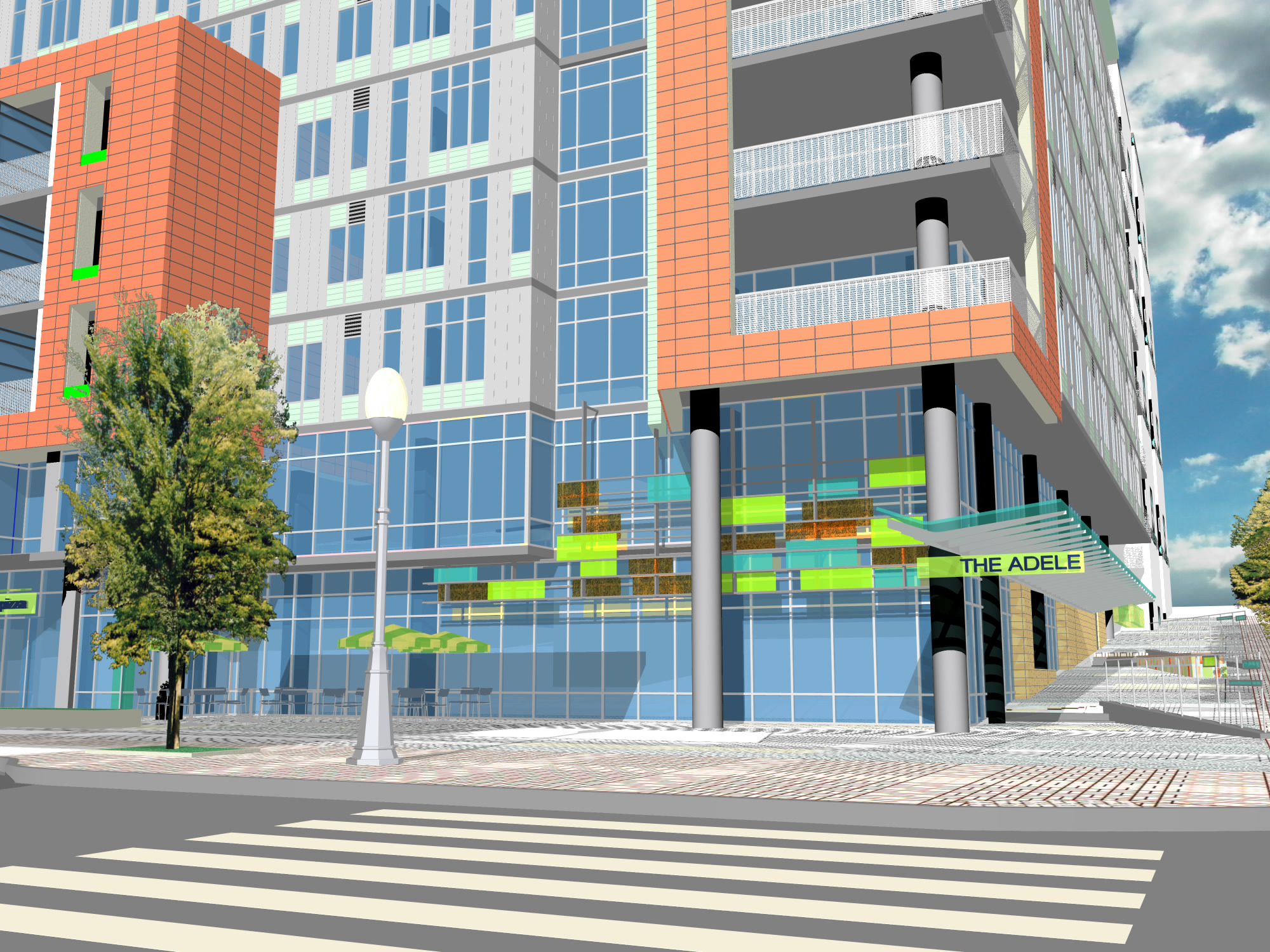
The original 2005 design concept - cast glass panels helped define the architectural entrance to the development.

The original 2005 design concept – cast glass panels helped define the architectural entrance to the “Adele” development.

Washington Glass Studio began creating artwork options for developments on the site, starting in 2005, when the site first was being developed as a residential development called “The Adele”. After a review and approval by Montgomery County Arts Council, the project languished as the real estate market changed.

In 2013, WGS Studio began working with the developers that purchased that project site, Redbrick LMD. Working with the design team, WGS artists were inspired by the rich mixture of ethnic groups in Silver Spring. Imagery and patterns that were based on the cultural fabric and textiles, as well as indigenous weaving and embroidery patterns for tapestries, wraps, blankets and garments.

Fabrics & textiles of the cultures that make up the Silver Spring neighborhoods was the inspiration of the new artwork design for 900 Thayer.

Fabrics & textiles of the cultures that make up the Silver Spring neighborhoods was the inspiration of the new artwork design for 900 Thayer.


Artwork on the corner column made up of backlit glass panels would be a colorful reference to the cultures, and add a bright pop of color on the site.

The corner location of the artwork would also frame out the proposed future planned arts development that would be up the road from 900 Thayer, and the Montgomery County Review committee was keen on having the artwork go further – asking if the artwork could be extended all along the ground level of the new development. Happily, Redbrick Developers agreed, and the scope of the artwork was extended along the entire street level and apartment outdoor spaces.

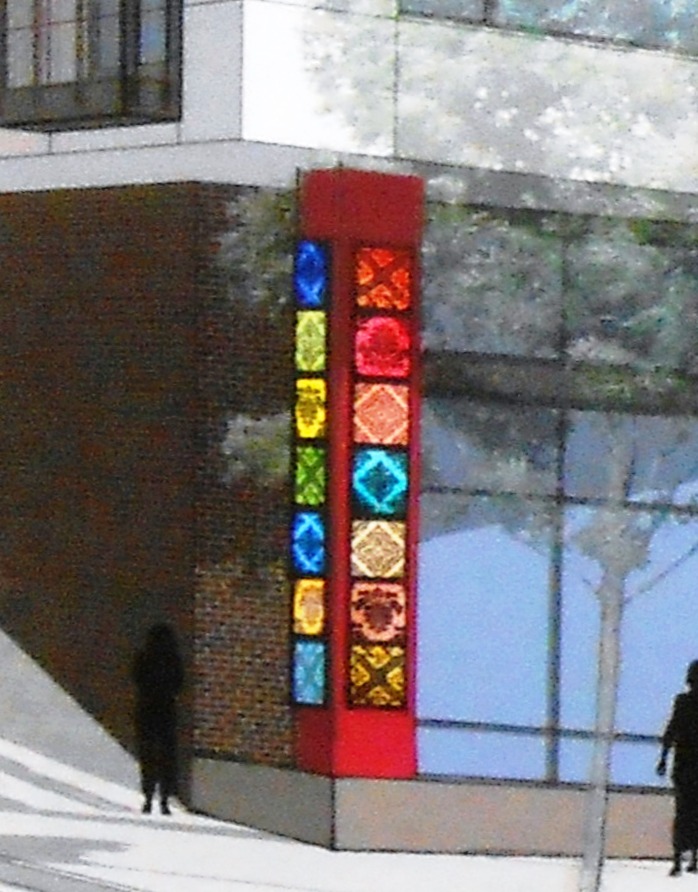
The corner column at 900 Thayer was to have an 11 foot high tower of backlit panels mounted to the surfaces.

The corner column at 900 Thayer was to have an 11 foot high tower of backlit panels mounted to the surfaces.

The project stalled in 2015. In 2017, Chesapeake Realty Partners joined with Redbrick Developer and the Housing Opportunities Commission of Montgomery County in moving forward with the property  proceeded with groundbreaking and construction of the development in June of 2018.

WGS Studio was contacted and engaged to fully develop the design. WGS revisited the idea of incorporating cultural textile and fabric patterns would encourage viewers to appreciate the colorful patterns enlivening the streetscape, as well as promoting a message of open-mindedness, promote tolerance and curiosity about other cultures.

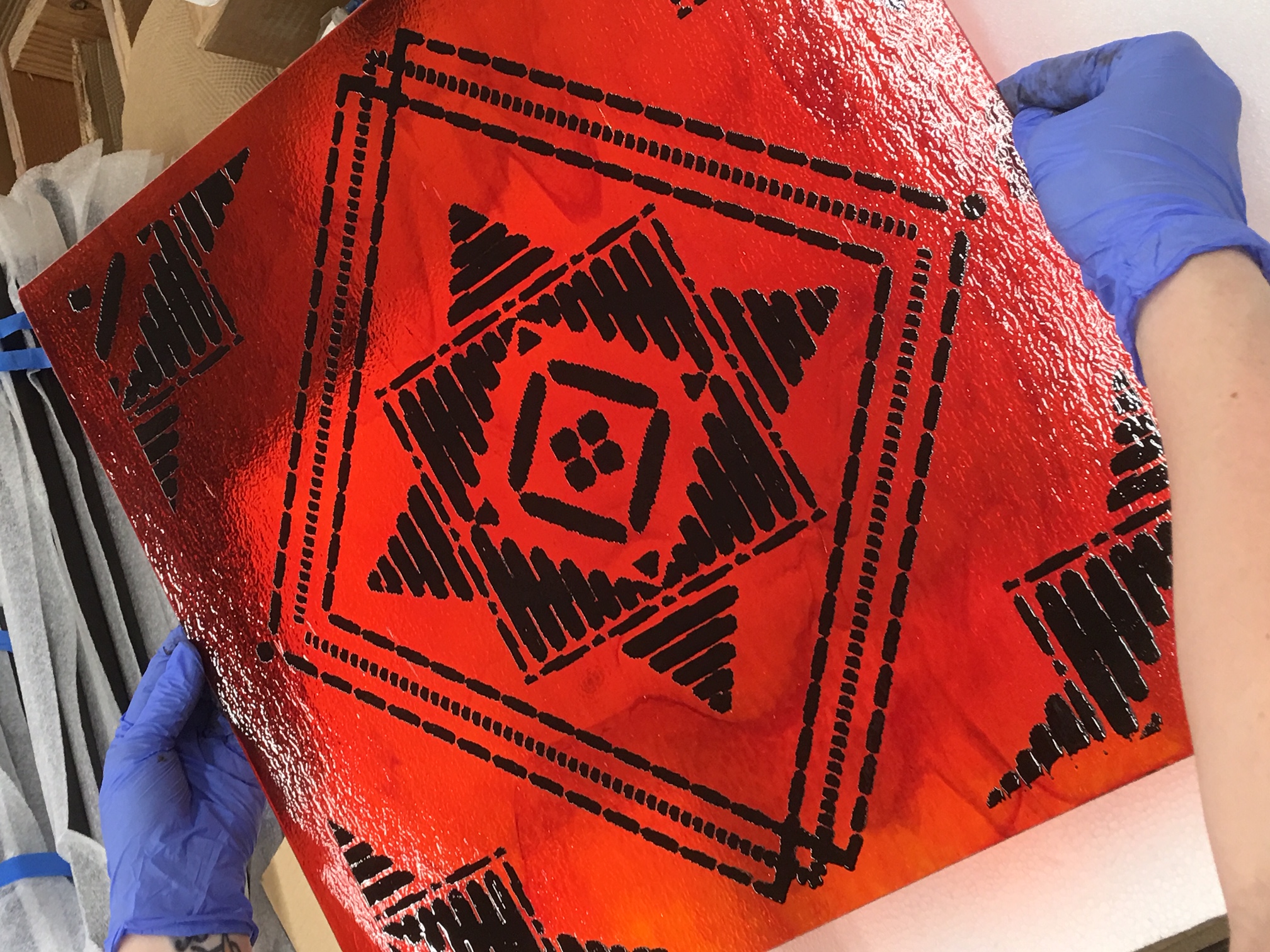
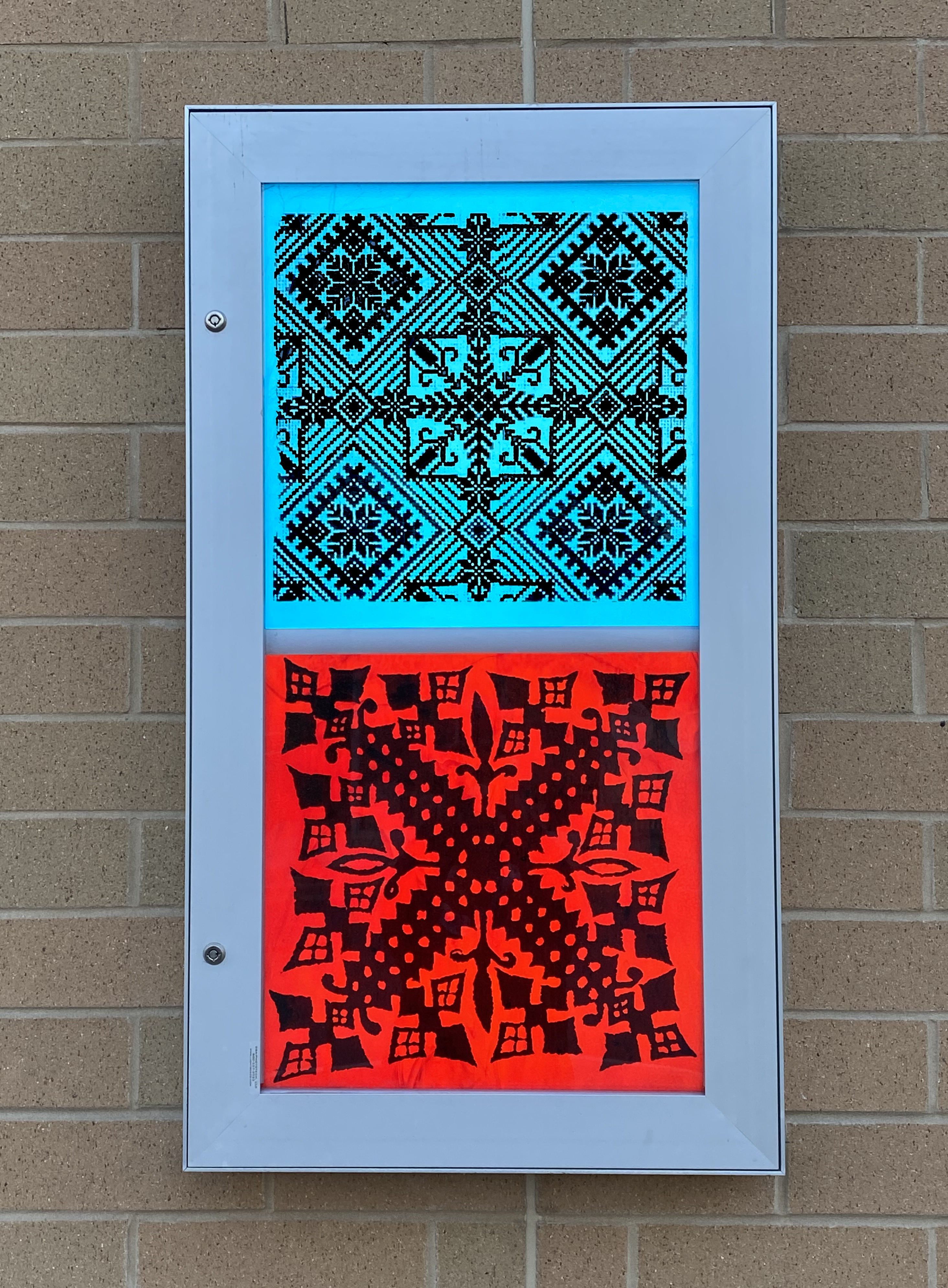
The brightly colored hand-screened glass features patterns were artistically based on Ethiopian textiles, African mudcoths, Central American weavings, European folkloric fabric prints, intricate and colorful ancestral weaving designs from Asia, Native American blankets, and Colonial American quilt patterns. Using identity and culture as the main theme of the building’s public artwork, WGS sought to inspire self-reflection, human connection, and conversation.

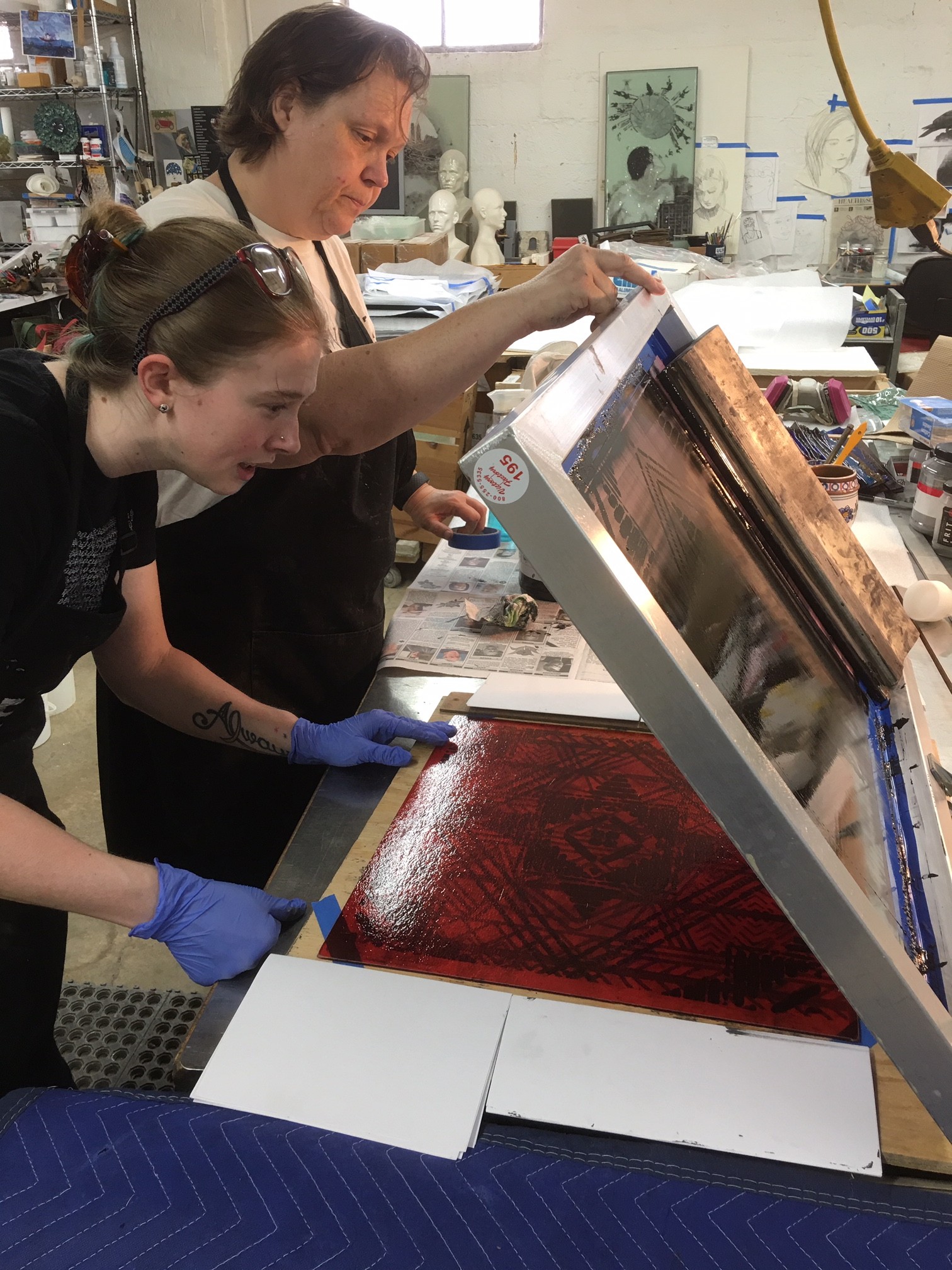
Teri Bailey and Patricia De Poel Wilberg work on silkscreening the enamel patterns on glass, to be fired in the kilns after.

Teri Bailey and Patricia De Poel Wilberg work on silkscreening the enamel patterns on glass, to be fired in the kilns after.

The Washington Glass Studio team worked on the production of the glass artwork starting in early 2019. Large silkscreen panels were made to allow the patterns to be enameled and fired in the WGS kilns. WGS Co-Director Erwin Timmers worked on the LED design and integration of the glass artwork.

The enameled glass was fired to keep the high contrast color selections vibrant.

The enameled glass was fired to keep the high contrast color selections vibrant.

Over 60 18″ x 18″ panels were made – and were to be mounted in a variety of multi-panel arrangements.

The installation on site began in October of 2019, and as the building occupancy needed the artwork to be completed to allow for certification, a focused WGS team made short work of the outdoor artwork installation. 

Detail of one of the LED illuminated glass panels at 900 Thayer Ave.

Detail of one of the LED illuminated glass panels at 900 Thayer Ave.

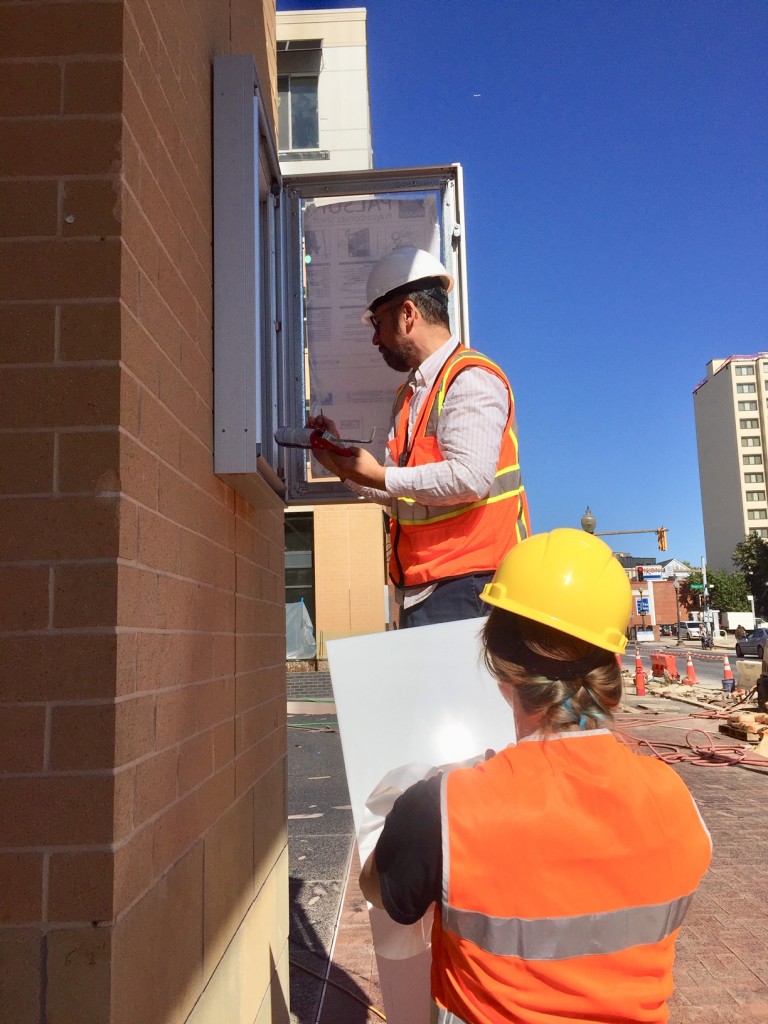
WGS Co-Director Michael Janis is a vision in orange as he preps the LED mounts for the glass.

WGS Co-Director Michael Janis is a vision in orange as he preps the LED mounts for the glass.

WGS Co-Director Erwin Timmers sets the final glass artwork panels in the corner column at the 900 Thayer site.

WGS Co-Director Erwin Timmers sets the final glass artwork panels in the corner column at the 900 Thayer site.

The Fenton Apartment corner column artwork has a strong presence in the daytime, with the LED illumination.

The Fenton Apartment corner column artwork has a strong presence in the daytime, with the LED illumination.

Project Details
Location: 900 Thayer Avenue, Silver Spring MD, 20910
Washington Glass Studio Public Art Team: Michael Janis, Tim Tate, Erwin Timmers, Teri Bailey and Patricia De Poel Wilberg.

Witness Tim Tate’s Infinite Mirror Sculpture

Artist Tim Tate has been pulling traditional craft into new realms and depths. Tim shared his newest series “Witnesses of Wonders” and the work is incredible. In this series,Tim has been using elements that were 3-D printed at Catholic University’s modeling department combined with infinity mirrors to expand the sensation of unlimited space in the artwork. 

From Tim’s artist statement about his series:

Tim Tate, "21st Century Guernica"; Glass, Cast Images, LED; 36" x 36 x 4". In this piece a ring of translucent refugee boats float in the center, all with no where to turn to. The center ring is shared with red poppies, the symbol for war remembrance in England. The outer edge is made up of individual images from the powerful Picasso painting entitled Guernica.

Tim Tate, “21st Century Guernica”; Glass, Cast Images, LED; 36″ x 36 x 4″. In this piece a ring of translucent refugee boats float in the center, all with no where to turn to. The center ring is shared with red poppies, the symbol for war remembrance in England. The outer edge is made up of individual images from the powerful Picasso painting entitled Guernica.

“I try to entice the viewer to look deeply into and completely experience my windows into alternative dimensions. My works create an optical and bodily illusion of infinity through apparently limitless space. There is an intimacy created by viewing deeply into a circular opening, as if peering through a portal to witness another endlessly repeating reality.

Tim Tate, 21st Century Guernica - detail .  Said Tim about the imagery of the refugee boats, " Refugees right now are trying to escape unspeakable atrocities and protect their families who are turned away at country after country. This is the shame of our decade. "

Tim Tate, 21st Century Guernica – detail . Said Tim about the imagery of the refugee boats, ” Refugees right now are trying to escape unspeakable atrocities and protect their families who are turned away at country after country. This is the shame of our decade. “


The constant repetition of imagery also speaks to us of timelines: ones that go endlessly into the future or extend endlessly into the past. These repetitions reference society mired into static social patterns, some good, some bad.

Tim Tate. "21st Century Guernica" detail.    "Picasso made his painting in mostly tones of black white and gray "to drain the life out of them". I drenched them in red and returned color to them because this horror is happening right now in this world....in fact this very second." said Tim Tate.

Tim Tate. “21st Century Guernica” detail. “Picasso made his painting in mostly tones of black white and gray “to drain the life out of them”. I drenched them in red and returned color to them because this horror is happening right now in this world….in fact this very second.” said Tim Tate.

We look inside these portals as if seeing into a dream, fully realizing that this is but an illusion. But even though we know it is a illusion that should not stop us from freely examining it, and hopefully seeing another world at the same time.

Tim Tate, "The Endless Cycle"; 36 x 36 x 4"; Glass, Aluminum, Poly-Vitro, electronics

Tim Tate, “The Endless Cycle”; 36 x 36 x 4″; Glass, Aluminum, Poly-Vitro, electronics

Uncomfortable with any single defining time, I prefer sliding through the centuries; from 19th century Victorian techno-fetishism, to mid and late 20th century references to endless mirrors and studio glass to 21st century electronics and political focus. Perhaps all my work can be defined by how uncomfortable I am with definitions.” Tim Tate.

For more images of Tim Tate’s newest works – click HERE to have a look at his website

Tim Tate, "The Endless Cycle". Said Tim about this work: "For every man shown here, 1000 people died last year because of gun violence. For every gun shown here, a child dies every day. A hard lesson we have to learn from Orlando.....only by joining together can we hope to curtail gun violence."

Tim Tate, “The Endless Cycle”. Said Tim about this work: “For every man shown here, 1000 people died last year because of gun violence. For every gun shown here, a child dies every day. A hard lesson we have to learn from Orlando…..only by joining together can we hope to curtail gun violence.”

Congrats Jeff Zimmer! Coburg Prize for Contemporary Glass

coburg.glass.zimmerThe Coburg Prize for Contemporary Glass – a European competition for modern glass – just announced the winners for 2014, and WGS alum Jeff Zimmer was awarded 2nd Place in this prestigious award!

At Germany’s Veste Coburg and the European Museum of Modern Glass in nearby Rödental, 170 works of art by 150 international artists from 26 nations.

jeffery.x.zimmer_coburg

Jeff Zimmer works his glass imagery at the Washington Glass School during a 2011 visit.

The international panel of judges consisted of Sven Hauschke, Veste Coburg Art Collections, Milan Hlaveš, Museum of Decorative Arts, Prague, Susanne Jøker-Johnsen, Bornholm, Peter Layton, London, Jutta-Annette Page, Toledo Museum of Art, Toledo/Ohio, Anne Vanlatum, Musée-Atelier départemental du Verre, Sars-Poteries and as a non-voting member Klaus Weschenfelder, Veste Coburg Art Collections, selected from the participating artists 11 prize winners.

jeff_zimmer.coburg.drone.glass.washington_school

Jeff Zimmer, “The Disconnect Between Action and Consequence (Drone I) 2013, Layered hand enameled glass, LED

Jeff’s socially conscious glass works have tremendous depth – due to the physical layering of glass plates. Jeff makes masterly use of the transparency of the medium and imbues his works with a sense of discomfort and ambiguity.

Big Congratulations Jeff!!