Harbor of Stories

Community Glass Public Art Sculpture Completed in Kempsville, Virginia

Washington Glass Studio completes “Harbor of Stories,” an 18-foot public art sculpture in Kempsville, Virginia Beach. Designed by Michael Janis and the WGS team, the glass and steel artwork combines community-made fused glass, cast glass narrative panels, and illuminated architectural sculpture exploring local history, ecology, and collective memory.
Harbor of Stories public art sculpture by Washington Glass Studio and the Kempsville community in April, 2026

The Washington Glass Studio has completed Harbor of Stories, a major new public art sculpture for the Kempsville area of Virginia Beach, Virginia.

Rising nearly eighteen feet high at the intersection of Princess Anne Road and Witchduck Road, the sculpture combines steel, cast glass, fused glass, and LED illumination into a landmark artwork shaped by community participation and layered local history.

Modeled after a stylized sail, the sculpture references Kempsville’s historic relationship to waterways, trade, movement, and cultural exchange. By day, sunlight activates the colorful glass surfaces; by night, integrated lighting transforms the work into a glowing beacon within the surrounding streetscape.

But Harbor of Stories was never intended to function as a traditional monument.

Instead, the project asked a more complicated question:

How can public art hold many histories at once?

Designing a Collective Portrait of Place

The RFQ for the Kempsville public art project stood apart from many civic commissions because it did not seek a single heroic narrative.

Early concept study by artist michael janis overlaying site photographs with initial massing sketches exploring visibility, movement, and sightlines along Witchduck Road and Princess Anne Road.
Early concept massing sketch exploring visibility, movement, and sightlines along Witchduck Rd.

The project called for artwork that could acknowledge overlapping histories connected to Indigenous communities, colonial settlement, Revolutionary War events, ecology, segregation, architecture, waterways, and contemporary neighborhood identity.

Historical research materials and archival ephemera gathered during the development of Harbor of Stories, informing references to Kempsville’s layered cultural and maritime history.
WGS sought to include many references to Kempsville’s layered cultural and maritime history.

For artist Michael Janis and the Washington Glass Studio team, this became an opportunity to explore how glass can carry layered narratives simultaneously.

The final design uses a sweeping sail form as both visual landmark and metaphor. The structure references Kempsville’s history as a working port while suggesting movement, migration, exchange, and shared memory.

Janis' Architectural elevation rendering of the evolving sail-form sculpture design for Harbor of Stories, integrating glass narrative panels within a steel framework.
Rendering of the evolving sail-form sculpture design for Harbor of Stories, integrating glass narrative panels within a steel framework.

Embedded throughout the sculpture are narrative glass panels created through multiple processes.

Clear cast glass bas-relief panels designed by Washington Glass Studio reference Indigenous presence, the Powhatan Mantle, the yehakin, local plant and aquatic life, colonial history, and the Battle of Kemp’s Landing during the American Revolution.

Collage of clear cast glass narrative panels featuring layered imagery of boats, wildlife, Indigenous references, plants, and historical scenes created for the Harbor of Stories public sculpture.
Cast glass bas-relief panels created by Washington Glass Studio depicting historical narratives integrated into Harbor of Stories.

These imagery-rich cast panels are interwoven with vibrant fused-glass panels created directly by community members during a year-long series of public workshops.

Together, the sculpture becomes less like a single memorial object and more like a collective portrait of place.

Community Collaboration Through Glass

A central component of Harbor of Stories was public participation.

Washington Glass Studio held hands-on workshops at the Kempsville Community Center and the Virginia Museum of Contemporary Art (Virginia MOCA), inviting local residents to create fused glass panels based on personal memories, experiences, and connections to the area.

Interior photograph at Virginia MOCA showing signage for a Washington Glass Studio community glass workshop connected to the Harbor of Stories public art project.
Virginia MOCA announcing glass-making workshops for the community art project.

Participants translated family stories, neighborhood imagery, landmarks, symbols, and aspirations into colorful glass compositions that now fill the sail structure.

Printed flyer for the Harbor of Stories community workshops featuring a diagram of the sailboat-inspired sculpture, event times, and information about glass-making sessions hosted by Washington Glass Studio.
Public workshop flyer at the Kempsville Community Center
Artists Michael Janis and Erwin Timmers greeting participants during a community glass workshop at the Kempsville Community Center.
Michael Janis and Erwin Timmers at Community Workshop

For many participants, this marked their first experience working with glass as an artistic material.

What emerged was not simply decoration, but authorship.

Kempsville residents proudly displaying their handmade fused glass panels created for inclusion in the Harbor of Stories sculpture.
Community Participants with Completed Glass Tiles

Each individual panel is modest in scale, yet together the hundreds of handmade elements create a unified visual voice that physically embeds community participation into the sculpture itself.

This process reflects one of Washington Glass Studio’s continuing interests within public art practice: creating projects where communities actively shape the artwork rather than simply receiving it after completion.

The Challenges of Public Art Fabrication

Like many large-scale public art projects completed in recent years, Harbor of Stories faced dramatic material and fabrication challenges during production.

As the project moved through engineering, approvals, and construction phases, steel prices rose substantially beyond earlier projections.

At one stage, the structural steel alone threatened to consume nearly the entire project budget.

Photo Collage combining structural engineering shop drawings with photographs of steel components being fabricated for the Harbor of Stories glass and steel sculpture by Washington Glass Studio.
Engineering plans and early steel fabrication process in shop.

Working closely with structural engineer Sante Taroli of Greenman-Pedersen, Inc., along with fabricators and city representatives, the team redesigned portions of the internal framework while preserving the sculpture’s outward appearance and structural integrity.

The project ultimately benefited from partnerships with fabricators more commonly associated with Defense Department construction work, including VTG Defense, whose expertise helped realize the complex steel structure.

Large sail-shaped steel sculpture structure fully assembled inside a fabrication shop for the Harbor of Stories public art project in Virginia Beach.
The sail-shaped steel sculpture structure fully assembled inside a fabrication shop.

The experience reinforced an important aspect of contemporary public art practice: successful civic artwork depends not only upon artistic vision, but upon sustained collaboration between artists, engineers, fabricators, architects, and public agencies.

Light, Glass, and Living Narratives

Back at the Washington Glass Studio, fabrication of the cast glass narrative panels continued simultaneously with construction of the steel armature at the metal shop.

Erwin Timmers bolting a steel-framed glass infill panel assembly onto the sail-shaped structure of the Harbor of Stories public artwork.
Erwin Timmers securing modular glass grid assemblies onto the sail structure during final installation.

For Washington Glass Studio, glass remains uniquely suited to commemorative and civic artwork because of its ability to hold texture, imagery, transparency, and light at the same time.

As sunlight passes through the sculpture, the embedded imagery continuously shifts throughout the day. Reflections, shadows, and transparency create an artwork that changes according to season, weather, and viewing position.

Artist Erwin Timmers carefully positioning a colorful fused glass panel into the steel framework.

Rather than functioning as a static monument, the sculpture behaves more like a living visual environment.

Michael Janis raising a large glass artwork panel toward the steel sail structure during installation of the Harbor of Stories sculpture in Virginia Beach.
Artist Michael Janis lifting a cast glass narrative panel into place during installation of the Kempsville public art sculpture.

This relationship between light and narrative has long been central to Washington Glass Studio’s public art practice, particularly in projects involving memory, identity, and collective history.

Installation and Dedication

Installation of Harbor of Stories took place over multiple phases as the steel framework, glass components, lighting systems, and structural elements were assembled on site.

The public dedication was held in April 2026.

Ribbon cutting ceremony for the Harbor of Stories public sculpture with artists, civic leaders, and community members gathered beside the illuminated glass sail artwork.
Community leaders, artists, and residents gather for the official ribbon cutting dedication of Harbor of Stories on April 18, 2026.

For the artists and collaborators, the most rewarding moment came when local residents began recognizing their own contributions within the finished sculpture — locating individual glass panels while experiencing the larger artwork as a shared civic space.

Two community participants pointing toward colorful glass panels they created and helped install within the completed Harbor of Stories public sculpture in Virginia Beach.
Kempsville residents search for and proudly identify their handmade fused glass panels within the completed Harbor of Stories sculpture.

The sculpture now stands not simply as an object placed within the neighborhood, but as a work grown directly from community participation and local history.

Dramatic upward perspective looking through colorful glass panels and steel framework inside the Harbor of Stories sail sculpture.
Upward view through the illuminated glass and steel sail structure revealing layered transparency, color, and light.

Project Team

Artists: Michael Janis, Erwin Timmers, Tim Tate, Arden Colley, and Ladan Ebrahimian

Structural Engineering: Sante Taroli / Greenman-Pedersen, Inc.

City of Virginia Beach Cultural Affairs and Public Art: Chad Clark and Emily Labow

Fabrication Partners: Thomas Willis / Production Welding and Fabrication; Randy Williams and Stephen Bittner / VTG Defense; Nick Lotuaco / L4 Builders

Group portrait of Washington Glass Studio team members Arden Colley, Ladan Ebrahimian, and Erwin Timmers sitting together during production of the Harbor of Stories public art sculpture.
Washington Glass Studio artists L-R Ladan Ebrahimian, Arden Colley, and Erwin Timmers relax at Harbor of Stories.

About Washington Glass Studio

Washington Glass Studio, based in Mount Rainier, Maryland, creates contemporary public art, architectural glass, sculpture, and community-engaged projects that integrate fine art, narrative imagery, and innovative glass techniques.

The studio’s public artworks frequently combine cast glass, fused glass, steel, and community participation to explore themes of history, identity, environment, and collective memory.

Washington Glass Studio Projects

Most of you know about the Washington Glass School’s extensive glass classes and the artwork, but many of you don’t know the third component of the Washington Glass Studio.  The Washington Glass Studio was established in 2001 to deliver artwork to the public realm by creating site specific art for architectural and landscape environments. Here is a highlight of a few recent projects to give a scope of what we are capable of producing.
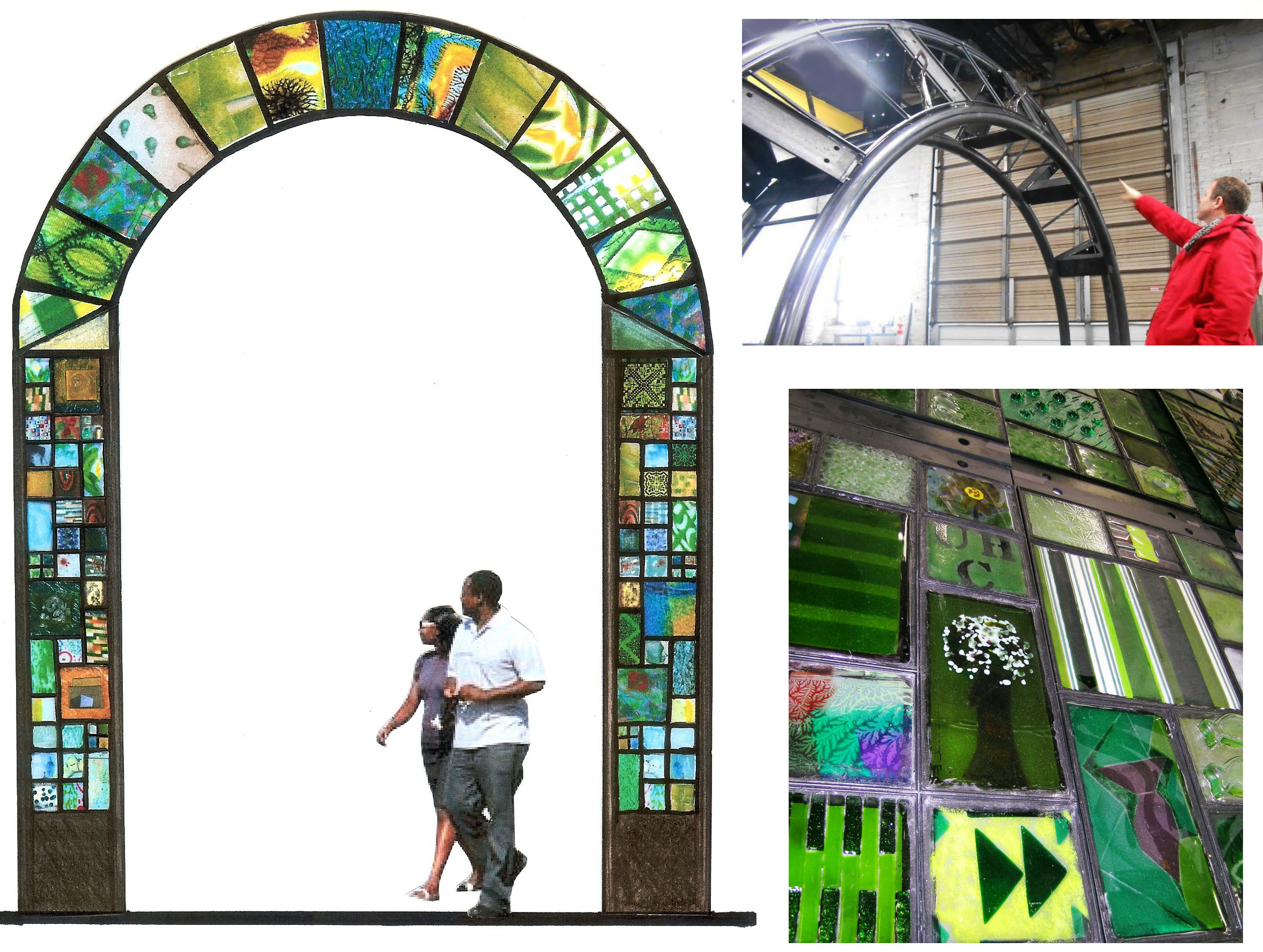
"Gateway To Community"   Glass and steel arch for Washington, DC Ward 7. Under Construction

“Gateway To Community” Glass and steel arch for Washington, DC Ward 7. Under Construction

We are currently finishing a commissioned public art sculpture in Washington, DC’s Ward 7 in front of the Unity Parkside Health Clinic and across the street from Caesar Chavez High School. This sculpture will be one of the first public art projects in Ward 7. Consisting of a 16 foot high tri-sided glass covered arch, the entire concept was derived from meeting with the community in the Kenilworth neighborhood.

The residents of the community participated in the creation of the glass elements for the public artwork sculpture.

The residents of the community participated in the creation of the glass elements for the public artwork sculpture.

Made up from steel tube sections the steel framework is clad in covered in colorful kilncast glass panels bolted to the structure. Over 300 tiles were required to complete the structure. These 300 tiles we all hand made by volunteers in the community surrounding the arch. The artwork will be internally illuminated with LED lighting throughout the sculpture. Installation is set for end of May/early June.
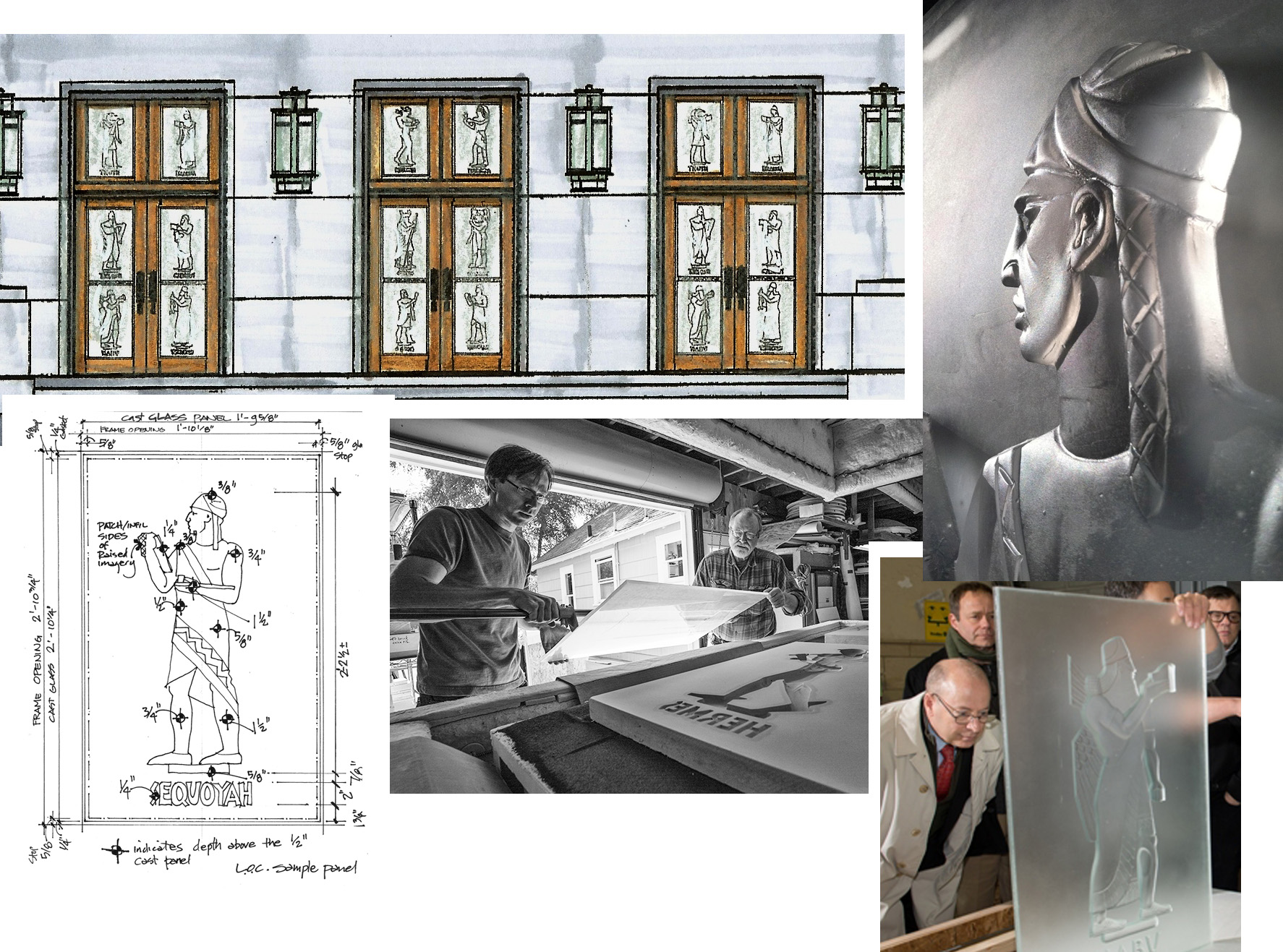
The Architect of the Capitol provides design direction for the historic Library of Congress Adams Building.

The Architect of the Capitol provides design direction for the historic Library of Congress Adams Building.

Of our recent public art works, the most acclaimed is our cast glass doors for the Library of Congress’ Adams Building. The original doors were cast bronze from the early WPA days. They were designed by Lee Lawrie, who is most known for his designs at Rockefeller Center in NYC. The original bronze bas-relief doors had ceased to be functional years ago, and the entrances were not up to current safety and security code. In a moment of courage and insight, one of the architects of the Architect Of The Capital’s office realized that if the bronze doors were redesigned with glass replicas of the original bronze bas-relief, then he could bring them up to code and increase safety, for much less money.  We then took on this multi-year project, with spectacular results.
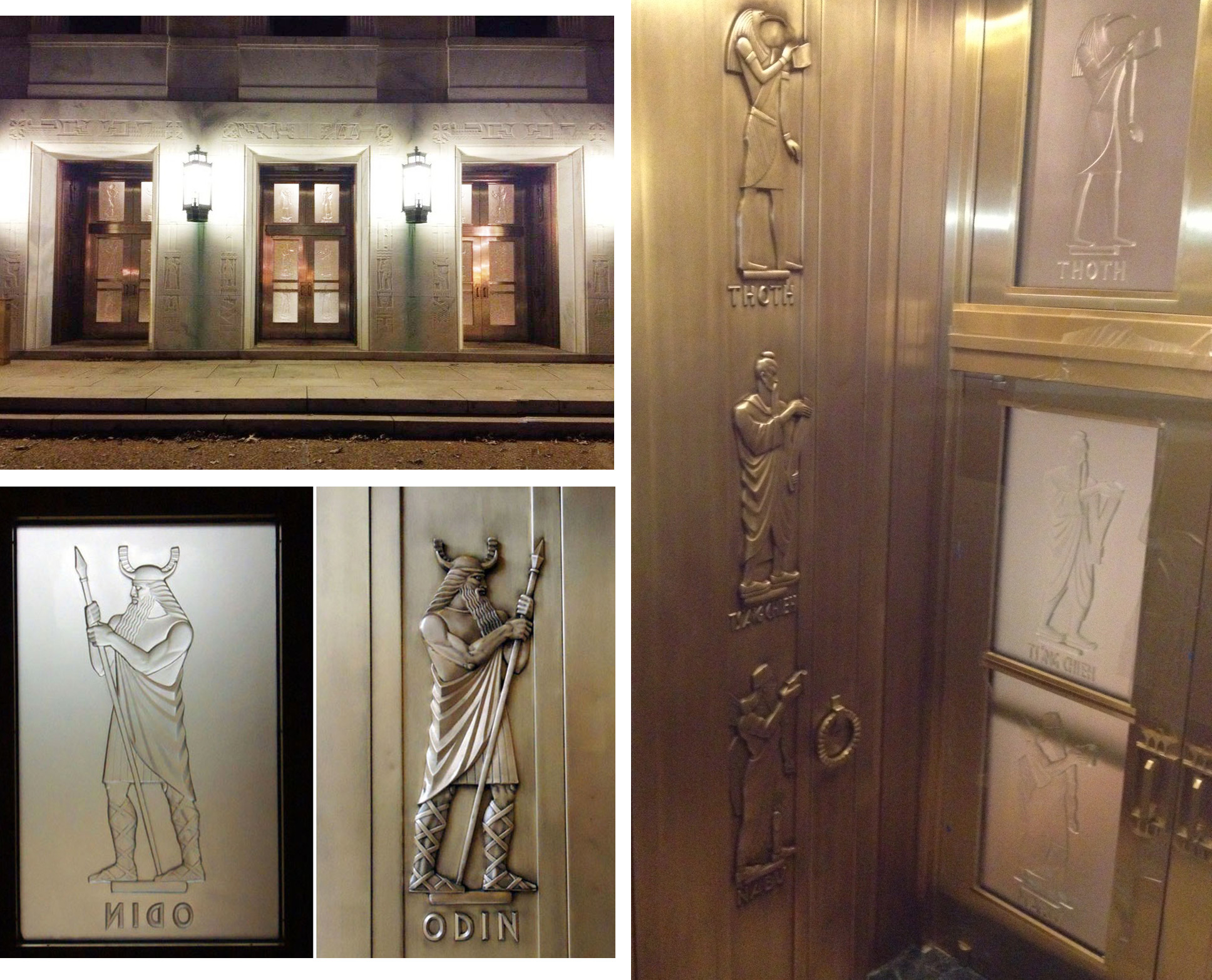
LOC.photo.1 good.finished

There were 6 sets of these doors, facing the east and west sides of the Adams Building. American Craft Magazine did a feature story on our work for the Library of Congress and its process – click here to jump to the magazine’s article online.

A smaller scale work was created for the charity organization “Food and Friends” new outdoor park. We made a cast glass Donor Wall that was to honor those who have passed away, to support to charitable work of the organization and to encourage donors to participate. Bas-relief cast glass panels in complementary colors set into a steel framework allows light to pass thru the memorial wall and create colors and patterns on the surrounding plaza. The nature of the glass panels encourages tactile investigation and contemplative interaction.
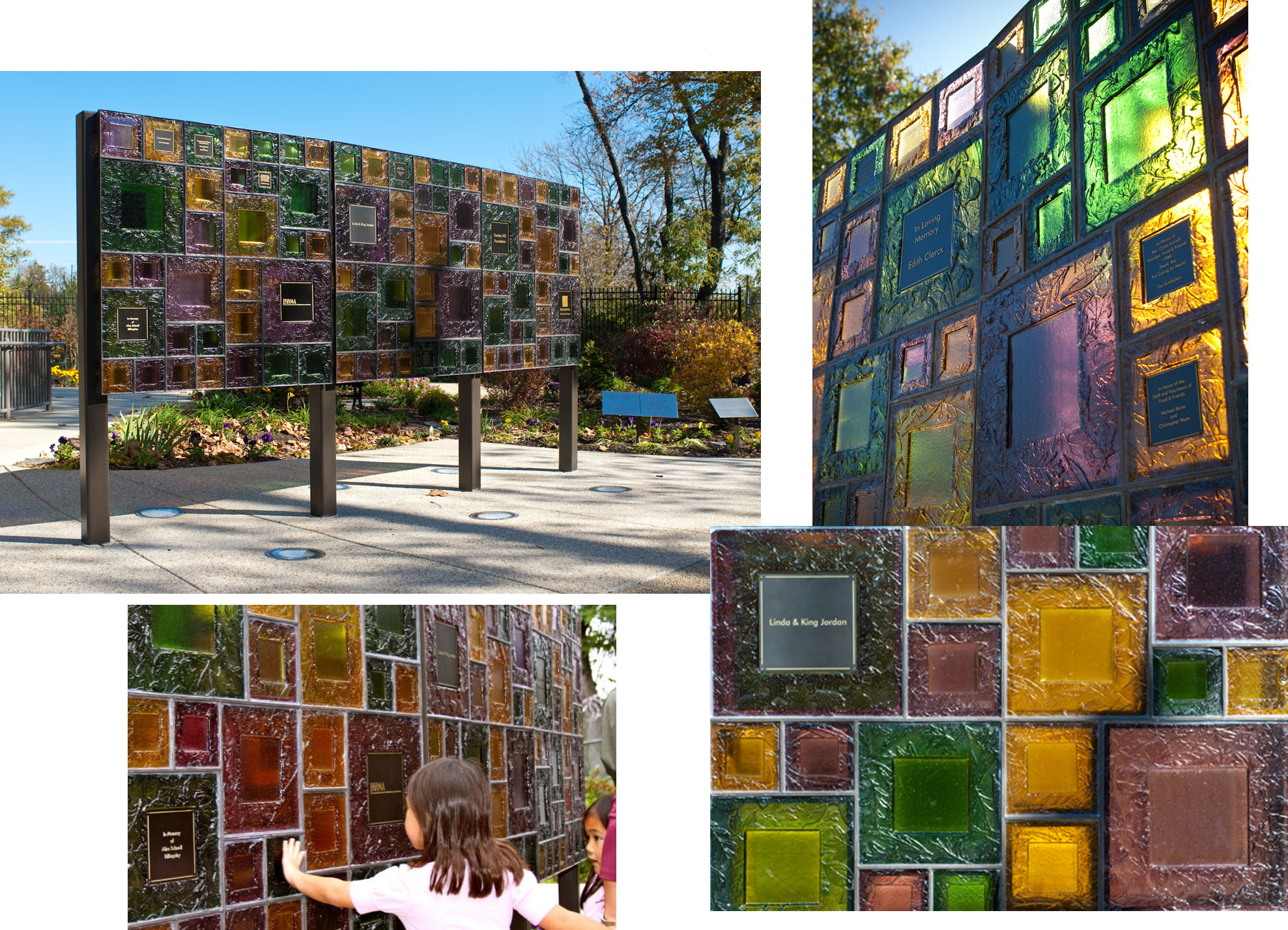
Food and Friends organization commissioned an outdoor donor wall for their park alongside their Riggs Road facility.

Food and Friends organization commissioned an outdoor donor wall for their park alongside the charity’s Washington, DC facility.

Lastly, one of our most distinguished works was for the Safeway supermarket Bethesda, Maryland. The original store was to be demolished to make way for a much larger structure with parking on the ground floor. As the grocer was committed to Green building, the new structure was to be the first LEED certified grocery store in Montgomery County, and we integrated eco-friendly materials, using recycled glass from the demolished store and re-purposing them to make the new glass and steel ground level building façade. The ground floor building skin was designed to conceal the parking garage function without completely enclosing it.  Here is the result:

Glass recycled from the original site's building was incorporated into Safeway supermarket's first LEED certified building in Montgomery County, MD.

Glass recycled from the original site’s building was incorporated into Safeway supermarket’s first LEED certified building in Montgomery County, MD.

This is only a fraction of what we have competed and what we are capable of doing. No job is too large or too complex. Our architectural design and technical team work well with architects and designers. We are currently looking for additional projects, so let us know in case you know of any, or know someone who might!